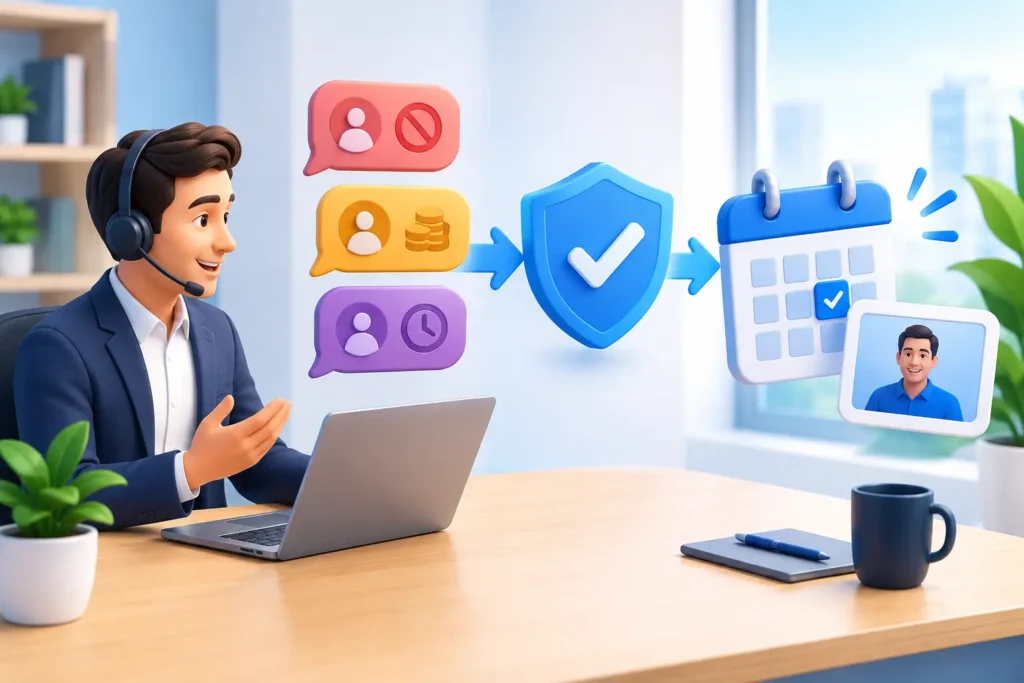

A booked meeting is not automatically a sales opportunity. If a BDR books conversations with people who lack authority, urgency, budget access, or a real use case, the calendar looks full while pipeline quietly stalls. Sales qualification frameworks give outbound teams a consistent way to separate genuine buying potential from polite interest before valuable closing time is consumed.
For growth-stage B2B companies, the goal is not to force every prospect through a rigid checklist. It is to establish enough evidence that a first meeting can move the sales process forward. The right framework creates that discipline without making outreach, discovery, or reporting feel robotic.
Why Sales Qualification Frameworks Matter in Outbound
Outbound creates a unique qualification challenge. Unlike inbound leads, many outbound prospects did not wake up looking for your product. They may recognize a problem when it is framed well, but they have not necessarily defined a project, secured a budget, or assembled a buying committee.
That does not make them poor prospects. It means the team must distinguish between two different states: a qualified account with an early-stage opportunity and a contact who is merely willing to take a call. Treating those as the same thing is one of the fastest ways to create false confidence in top-of-funnel performance.
A practical framework helps a go-to-market team answer four commercial questions:
- Is this company within our ideal customer profile?
- Is the person involved in, or close to, the buying process?
- Is there a credible business problem we can help solve?
- Is there a realistic path to a next step?
When those answers are captured consistently, leaders can inspect pipeline quality, improve targeting, and coach BDRs based on evidence rather than anecdotal feedback. It also protects account executives from spending their week running introductory calls with companies that were never viable customers.
The Best Framework Depends on the Sale
There is no universal winner among sales qualification frameworks. A $15,000 annual SaaS sale to a department leader requires different evidence than a six-figure enterprise services engagement with security, legal, procurement, and executive stakeholders involved.
The mistake is adopting a recognizable acronym because it is familiar, then requiring reps to collect information that a buyer cannot reasonably provide in an initial conversation. Qualification should match deal complexity, contract value, sales cycle, and your buyer’s level of awareness.
BANT for Fast, Straightforward Transactions
BANT evaluates Budget, Authority, Need, and Timing. It remains useful when the buying motion is relatively simple, the economic buyer is accessible, and prospects commonly enter the market with defined requirements.
For outbound teams, BANT is often too strict if used as a gate before booking any meeting. A director may have a clear need and direct influence but no approved budget until they build an internal business case. Rejecting that conversation prematurely can eliminate opportunities that a strong account executive could develop.
Use BANT as a signal of deal readiness, not a demand for perfect information. It works especially well for assessing whether an opportunity should receive immediate sales attention versus structured nurture.
MEDDICC for Complex Enterprise Opportunities
MEDDICC examines Metrics, Economic Buyer, Decision Criteria, Decision Process, Identify Pain, Champion, and Competition. It is designed for complex sales where multiple stakeholders, risk concerns, and formal procurement processes shape the result.
This framework is powerful because it forces the team to consider how a deal will actually get approved. A prospect’s enthusiasm is useful, but it is not the same as a champion who can build internal consensus, navigate decision criteria, and connect your solution to measurable business outcomes.
The trade-off is operational. A BDR should not be expected to fully validate every MEDDICC field in one cold-call conversation. Early outreach can establish pain, relevant metrics, role in the decision, and a credible reason to meet. Deeper elements should be owned jointly by the account executive and sales leadership as the deal advances.
SPICED and SPIN for Discovery-Led Motions
SPICED focuses on Situation, Pain, Impact, Critical Event, and Decision. SPIN centers on Situation, Problem, Implication, and Need-payoff questions. Both are useful when the sale depends on helping buyers articulate a problem they have not fully quantified.
These approaches fit consultative sales motions, specialized services, and technology products that solve operational challenges buyers may tolerate until the cost of inaction becomes clear. They help teams avoid a common outbound failure: pitching capabilities before establishing whether the issue matters enough to change behavior.
Build a Qualification Model Around Your ICP
A framework is only effective when it starts with account fit. An enthusiastic prospect at the wrong company can still become a costly distraction.
Before assigning qualification criteria to BDRs, define the account attributes that correlate with successful customers. This may include company size, industry, technology environment, geographic footprint, growth stage, regulatory pressure, hiring patterns, or a triggering event such as expansion, funding, or a leadership change.
Then separate account qualification from opportunity qualification. Account qualification asks whether the company belongs in your target market. Opportunity qualification asks whether there is a problem, stakeholder, and next step worth pursuing now.
That distinction matters when building outbound campaigns. A company can be a strong ICP match even if the first contact says timing is not right. It may deserve disciplined follow-up, not immediate disqualification. Conversely, a contact may request a demo at a company that cannot support your commercial model. That should not become a sales-ready meeting simply because the prospect responded.
Define What a Qualified Meeting Actually Means
Most pipeline problems start with an ambiguous handoff standard. Marketing calls a lead qualified because they downloaded content. A BDR calls a meeting qualified because it was accepted. Sales calls it qualified only if the prospect has an active budget and a live project. Everyone can claim success while revenue teams work from different definitions.
Create a written standard for a sales-ready meeting. For many B2B outbound programs, it should require a confirmed ICP fit, a relevant contact, an identified challenge or business objective, and agreement to a specific next conversation. The prospect does not need to know every detail of their procurement process. They do need a reason to engage beyond general curiosity.
Document what must be captured before a meeting is passed to sales. Keep it practical: the account context, contact role, stated pain or goal, current approach, timing signal, and agreed next step. This gives the account executive enough context to prepare and gives leadership a reliable audit trail.
A useful rule is that qualification notes should explain why this prospect agreed to talk now. If the notes only say interested in learning more, the team has not qualified the opportunity. It has recorded a response.
Use Progressive Qualification, Not Interrogation
Prospects do not owe a cold caller a full business case. Asking about budget, decision authority, implementation timing, and competitive alternatives in the first two minutes can end a conversation that had real potential.
Use progressive qualification instead. The first interaction should confirm relevance and earn a next step. The BDR can ask direct but natural questions: What prompted you to take this conversation? How are you handling this today? Is this a priority for your team this quarter, or something you are evaluating further out?
As engagement increases, the account executive can map stakeholders, quantify impact, identify decision criteria, and test the path to purchase. The framework remains the same, but the depth of evidence grows with buyer trust.
This approach also improves personalization. When a prospect signals a future initiative rather than current urgency, the right response is not repeated generic follow-up. It is a thoughtful nurture plan tied to their likely trigger, timeline, and role.
Make Qualification Visible in Your Operating Rhythm
Qualification fails when it lives only in a rep’s head. Make it part of the funnel infrastructure.
Require structured CRM fields for the few criteria that materially affect conversion. Pair those fields with concise free-text notes so the human context is not lost. Review meeting quality by campaign, segment, persona, and BDR, not only by total meetings booked.
The most useful downstream metrics are meeting-to-opportunity conversion, opportunity-to-close conversion, sales-cycle length, and average contract value. If a campaign produces many accepted meetings but few opportunities, the issue may be targeting, messaging, qualification, or the handoff itself. The data should guide the diagnosis.
An embedded outbound team should report these patterns openly. At Oppify, outbound execution is treated as part of the client’s revenue function, which means booking meetings is not the finish line. The work includes refining ICP assumptions, messaging, follow-up, and qualification criteria as real market feedback comes in.
Keep the Framework Accountable to Revenue
A qualification framework should improve over time. Review closed-won and closed-lost opportunities to identify which signals predicted success and which requirements were noise. You may find that budget was rarely known early but a specific operational trigger strongly correlated with conversion. Or that one persona consistently attended meetings but could not drive internal action.
Refine the criteria, train the team, and keep the standard clear. The best framework is not the one with the most letters. It is the one your team can execute consistently, your buyers can engage with naturally, and your revenue data can prove worthwhile.
A full calendar can be purchased. A qualified pipeline has to be earned, one well-targeted conversation and one disciplined handoff at a time.