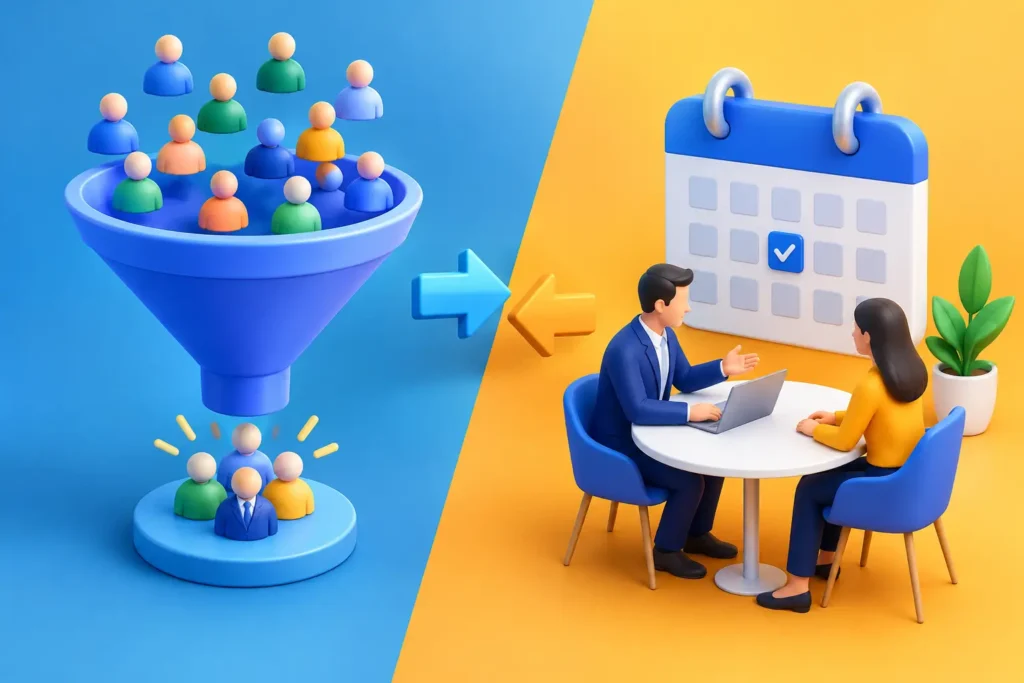


A new market outbound strategy is not a higher-volume version of the outreach that worked in your core segment. It is a controlled commercial test. Your team is trying to determine whether a defined set of buyers has a problem you can solve, whether your positioning earns attention, and whether the resulting opportunities can move through a real buying process.
That distinction matters. Many companies enter a new vertical, geography, or customer tier with a broad account list and a familiar pitch. They may generate replies, but they do not generate reliable pipeline. The market was never properly defined, the message was not built for the buyer’s operating reality, and the sales team has no signal for deciding what to repeat.
A disciplined outbound motion turns market entry into an accountable process: collaborate on the hypothesis, prospect the right accounts, run coordinated outreach, qualify opportunities, report what is working, and repeat only after the data supports it.
Start With a Market Hypothesis, Not a List
The first job is to make the market specific enough to test. “Healthcare,” “mid-market SaaS,” or “enterprise services” are categories, not outbound segments. A useful hypothesis identifies the type of company, the people involved, the conditions that create urgency, and the commercial reason your offer should matter now.
For example, a security platform may not target all healthcare companies. Its first test might focus on multi-location provider groups that are adding new systems, have growing compliance exposure, and employ a CIO or security leader with a documented mandate to reduce vendor sprawl. That creates a targetable account universe and a message with a credible point of view.
Your hypothesis should answer three questions in plain language: Who is most likely to feel the problem? What event or operating condition makes it urgent? Why is your solution a better alternative than the status quo?
If leadership cannot answer those questions without relying on vague value statements, outbound execution will expose the gap quickly. That is useful, but it is an expensive way to learn. Do the strategic work before asking BDRs to create conversations.
Separate market potential from immediate accessibility
A large total addressable market does not automatically make a good first outbound market. The best initial segment is often smaller, but easier to identify and reach. It has accessible decision-makers, visible triggers, a clear use case, and a sales cycle your company can realistically support.
A new enterprise segment may offer higher contract values, for instance, but require security reviews, procurement resources, integrations, and executive credibility your current sales process does not yet have. That does not mean avoid enterprise. It means build the entry strategy around the actual friction rather than declaring victory after booking a few curious meetings.
Build the Account Model Before Writing Copy
Outbound quality begins with account selection. A well-written email sent to the wrong company is still wasted activity. Before campaigns launch, define the account attributes that distinguish a likely buyer from a company that merely fits basic firmographics.
This model should include industry, company size, geography, growth stage, technology environment where relevant, and operational triggers. It should also account for exclusions. A company can look attractive on paper but be a poor prospect if it lacks the budget profile, regulatory need, buying maturity, or implementation capacity for your offer.
Then map the buying group. Complex B2B sales rarely depend on one title. The economic buyer may care about cost, growth, or risk. The functional champion cares about workflow improvement. A technical evaluator may determine whether the product can be deployed. Procurement and finance can slow a deal long after initial interest appears.
Do not treat every contact as interchangeable. Give each role a reason to engage that reflects what they own. A VP of Sales may respond to revenue leakage and rep productivity. A RevOps leader may care more about data quality, process control, and reporting reliability. The product is the same, but the conversation should not be.
Create a Message That Earns a Reply
New-market messaging needs to lead with the buyer’s context, not your company’s capabilities. The prospect should recognize a business issue before they are asked to evaluate a solution.
That requires research at two levels. First, identify recurring market conditions: new regulations, hiring pressure, expansion activity, tool consolidation, changes in customer expectations, or margin constraints. Second, personalize around the account: a leadership change, product launch, growth initiative, new facility, acquisition, or a public strategic priority.
Personalization does not mean inserting a recent news item into a generic template. It means connecting a relevant observation to a credible reason for outreach. If that connection is weak, skip it. Forced personalization can reduce trust faster than a concise, direct message.
A strong first-touch message generally establishes relevance, names a specific business outcome, offers a differentiated point of view, and asks for a low-friction conversation. Avoid trying to explain the entire product. The goal is not to close in an email. It is to earn enough interest for a qualified first meeting.
Run Multichannel Outreach With a Clear Operating Cadence
Email alone is rarely enough for a new market. Senior buyers are busy, inboxes are crowded, and a market that does not know your brand may need repeated exposure before responding. A coordinated sequence across cold email, LinkedIn, and cold calling gives the campaign more chances to create a real conversation.
The channels should reinforce one another rather than repeat the same message. An email can introduce the business problem. A call can test whether the problem is timely and uncover the right owner. A LinkedIn interaction can add familiarity without becoming a generic connection request.
Cadence should be persistent but disciplined. If an account has clear fit and a meaningful trigger, multiple touches are justified. If the account does not fit or the message has no evidence of resonance, more activity will not fix the underlying problem. This is where experienced BDR judgment matters. Automation can manage workflow and signal prioritization, but it cannot replace human qualification, call control, and follow-up.
Protect deliverability and brand credibility
Early market-entry campaigns should not be used to push sending volume. New domains, weak list hygiene, and aggressive automation can damage deliverability before your team has learned what works.
Start with a focused account set and tightly managed inbox infrastructure. Monitor delivery, opens where meaningful, replies, positive response rates, calls connected, meetings held, and opportunities created. A campaign that produces meetings but no viable next steps may have a targeting or qualification problem. A campaign with low engagement may have a list, message, or channel problem. Those are different fixes.
Define What Counts as a Qualified Meeting
Booked meetings are not the finish line. For a new market, the more useful question is whether meetings produce evidence that the segment can become repeatable revenue.
Set qualification criteria before outreach begins. At a minimum, define the required account fit, the buyer role, the business problem, the timing, and the next step that indicates real momentum. Your criteria can vary by sales motion. A high-ticket enterprise offer may accept earlier executive discovery if the account is strategically valuable. A lower-priced SaaS offer may require stronger need and timeline signals before a meeting reaches the sales calendar.
The handoff also needs structure. Sales should receive the account context, contacts engaged, outreach history, stated pain points, objections, meeting purpose, and recommended next step. Without this, the closer starts from zero and the prospect experiences a disjointed transition.
Oppify operates this process as an extension of the client’s go-to-market team because meeting generation only creates value when outreach, qualification, and sales follow-up operate as one system.
Use Reporting to Decide What to Scale
A new market outbound strategy should produce decisions, not just activity reports. Weekly reporting should show where the funnel is holding and where it is breaking: accounts researched, contacts reached, engagement by persona, conversations, meetings booked, meetings held, sales-accepted opportunities, and pipeline created.
Pair the numbers with qualitative feedback. Objections reveal whether the market lacks urgency, misunderstands your category, already has a substitute, or needs a different proof point. Sales-call notes may show that one buyer persona consistently champions the deal while another only responds but cannot drive action.
Do not pivot after ten sends or declare product-market fit after three meetings. Look for patterns across enough high-quality account activity to separate random variation from market signal. At the same time, do not cling to a segment because it is strategically attractive. If quality targeting, credible messaging, and consistent follow-up are not producing qualified conversations, adjust the hypothesis.
The goal is not to make a new market look promising on a dashboard. It is to build a repeatable path from named accounts to qualified meetings, sales opportunities, and revenue. Start narrow, learn quickly, and earn the right to scale.