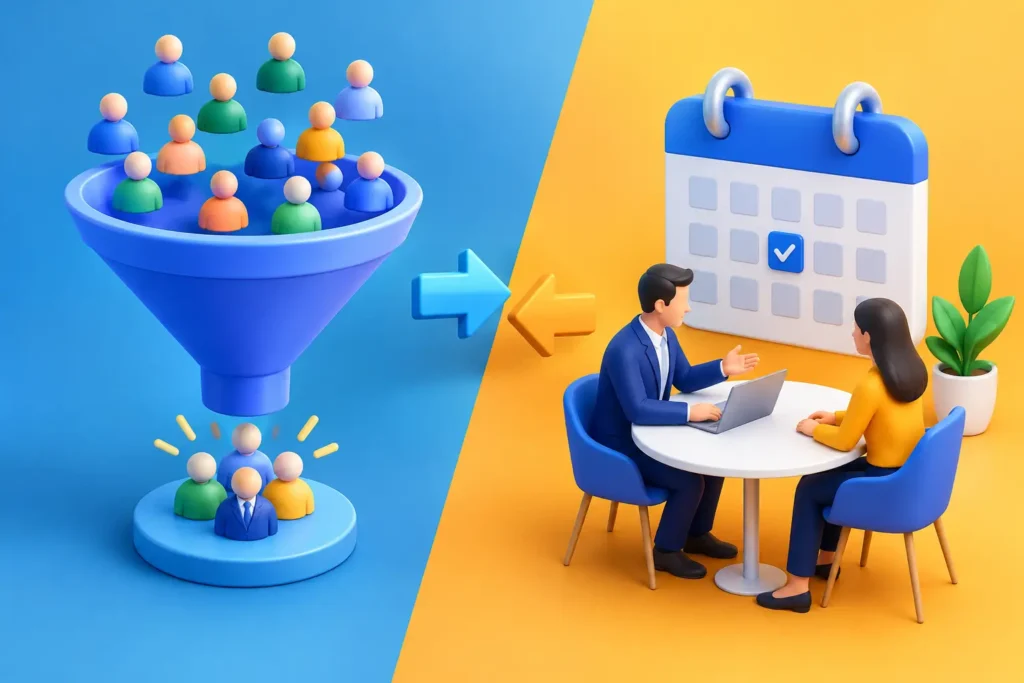


A calendar full of introductory calls is not an enterprise pipeline strategy. For companies selling complex software, specialized services, or high-consideration solutions, the right enterprise meeting generation examples show a more demanding standard: reaching the right buying committee, creating a credible reason to talk, and qualifying the opportunity before it reaches an account executive.
Enterprise outbound works when it is treated as a coordinated revenue function, not a volume exercise. The examples below show what that looks like in practice, including the trade-offs that determine whether a campaign creates revenue opportunities or just activity.
What Enterprise Meeting Generation Must Accomplish
An enterprise meeting is rarely won with one email or one person. A security leader may feel the operational pain, a VP may own the initiative, procurement may shape the commercial path, and finance may ultimately approve the purchase. Meeting generation has to account for that reality from the beginning.
That means the objective is not simply to identify companies that fit an industry filter. The objective is to identify accounts with a plausible business case, find the people who can advance a conversation, and use messaging that earns a response without pretending a major buying decision is easy.
For an early-stage company, the first priority may be validating a new ICP. For a growth-stage business with a proven sales motion, it may be creating consistent coverage across a defined enterprise segment. The channels can look similar, but the operating model should not.
5 Enterprise Meeting Generation Examples
1. Trigger-led outreach to a defined account list
A cloud infrastructure provider wants meetings with companies that are likely struggling with escalating cloud costs and fragmented governance. Instead of sending a broad campaign to every company above 1,000 employees, the outbound team builds a focused list around companies with recent cloud hiring, rapid product expansion, new engineering leadership, or public signs of infrastructure change.
The message does not claim to know the prospect’s exact spend. It connects the observable trigger to a relevant operational question: how the company is handling cost visibility and guardrails as its environment expands. A BDR then calls and follows up on LinkedIn with a concise point of view tailored to the account.
This approach works because the trigger gives outreach timing and relevance. It does require disciplined research. If the trigger is stale, weak, or unrelated to the buyer’s priorities, personalization becomes decoration rather than a reason for a meeting.
2. A multi-threaded campaign around a shared business problem
A cybersecurity company is selling into regional healthcare systems. Its product affects security, IT operations, compliance, and clinical continuity, so a single-threaded campaign to the CISO is too narrow.
The campaign starts with a coordinated account map. Security leaders receive messaging about risk exposure and response readiness. IT operations leaders receive a practical angle on deployment burden and visibility. Compliance stakeholders receive a message tied to audit pressure and evidence collection. The core issue is consistent, but each role sees why the discussion matters to their function.
When one contact engages, the outbound team does not immediately treat that response as a closed win. It uses the engagement to identify the project owner, current process, relevant stakeholders, and the reason timing may be real. That allows the first meeting to include the right people or establish a credible path to them.
The trade-off is speed. Multi-threading takes more planning than blasting one persona, but enterprise deals often stall because the initial champion cannot explain the value internally. A wider, role-aware entry point reduces that risk.
3. A territory expansion campaign with local proof
A specialized professional services firm is entering a new US market. Its sales team has strong results in existing regions, but no established pipeline or local reputation in the new territory.
Rather than positioning the campaign as a generic introduction, the outbound team segments accounts by local industry concentration, company size, and likely service need. Messaging references relevant outcomes from similar client environments without overclaiming market expertise. Calls are timed around business hours in the territory, and the team tracks which vertical messages generate real conversations.
The first meetings are qualified around the buyer’s current initiative, incumbent relationship, budget process, and decision timeline. This matters because a regional expansion can otherwise fill the funnel with firms that are interested in the category but not prepared to change providers.
For market-entry campaigns, early results should be used to refine the ICP. If one vertical responds but consistently lacks budget, that is not success. If another vertical books fewer meetings but creates larger, more qualified opportunities, the campaign should shift resources accordingly.
4. Re-engaging dormant enterprise opportunities
Not every qualified meeting comes from a net-new account. A B2B SaaS company may have hundreds of past conversations that ended because the timing was wrong, an integration was missing, or the buyer chose to maintain the status quo.
A disciplined reactivation campaign separates those records by loss reason, buyer role, account maturity, and time since the last conversation. Messaging then reflects what has changed. It might be a new capability, a newly relevant compliance requirement, a business event at the account, or a clearer value case based on lessons from similar customers.
The key is restraint. A message that says, “Just checking in,” gives an enterprise buyer no reason to reply. A message that explains a specific change and asks whether the previous obstacle still applies can reopen a serious discussion.
This is often one of the most efficient enterprise meeting generation examples because the account already knows the category. Still, old CRM records are not automatically good prospects. Contact data must be verified, prior notes must be reviewed, and the campaign should avoid treating a past no as a permanent maybe.
5. Creating meetings from an executive-level point of view
A data platform selling to large financial services firms may struggle if its outreach focuses only on product features. Senior buyers are not looking for another generic discussion about dashboards or integrations. They are evaluating strategic exposure, operational priorities, and the cost of delay.
In this case, the campaign is built around a concise executive point of view. It may address the hidden cost of manual reporting, the difficulty of governing data across business units, or the gap between AI initiatives and data readiness. The outreach offers a relevant discussion, not a forced product demonstration.
The BDR’s job is to turn interest into a qualified first meeting. That requires asking whether the issue is active, who owns it, how the company is handling it now, and whether there is a business event driving urgency. An account executive should enter the conversation with context, not a calendar invitation and a company name.
Executive messaging can create high-value conversations, but it is not a shortcut around relevance. A polished insight that does not match the account’s priorities will be ignored. The strongest campaigns pair a sharp point of view with evidence that the selected accounts are likely to care.
How to Turn Examples Into a Repeatable Engine
The difference between a one-off campaign and a meeting-generation engine is operational discipline. Start with a written ICP that goes beyond firmographics. Define the business conditions that make an account more likely to buy, the roles involved in a first conversation, the disqualifiers that should remove an account from outreach, and the signals that justify immediate follow-up.
Next, build messaging by role and channel. Email can introduce the business case. LinkedIn can add familiarity and social context. Cold calling can surface direct feedback quickly and reach buyers who do not respond in writing. Each touch should move the conversation forward rather than repeat the same pitch in a different format.
Qualification needs a clear standard. A meeting is not qualified simply because a senior title accepted it. The outbound function should confirm the account fit, the relevant problem, the stakeholder’s role, the current approach, and a reasonable next step. Some enterprises will not disclose budget or timeline early, and forcing those questions can damage the conversation. In those cases, confirm enough context to determine whether an account executive’s time is justified.
Finally, report on more than booked meetings. Track account coverage, positive response quality, conversations by persona, show rate, qualification rate, pipeline created, and progression after the first call. A campaign that books meetings but produces no second conversations has a targeting, messaging, or qualification problem.
Oppify approaches this work as an embedded outbound function: research, targeting, campaign execution, follow-up, and reporting operate together so the sales team can focus on advancing real opportunities.
The most useful question is not, “How many meetings can we book?” It is, “Which conversations are most likely to create a credible path to revenue, and what must our team do to earn them?” Build the answer into the account list, the message, the follow-up, and the qualification process. That is where enterprise pipeline starts.