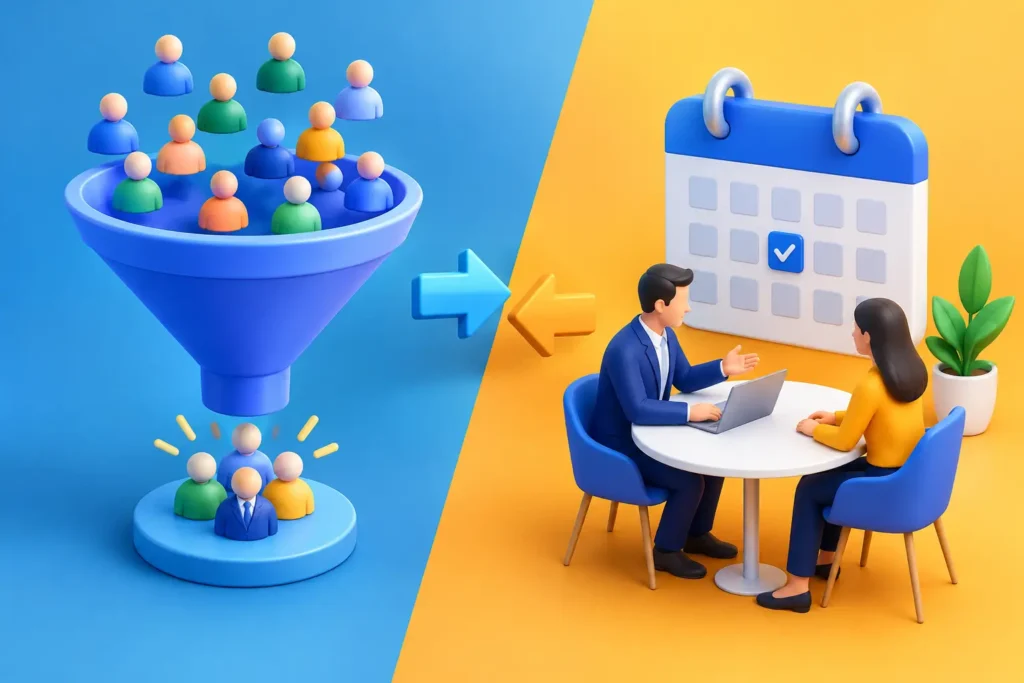


A full calendar is not proof that outbound is working. If your AEs are taking meetings with companies that lack budget, authority, urgency, or a credible use case, activity is becoming expensive noise. This ideal customer profile guide is built for B2B teams that need to turn limited sales capacity into qualified pipeline, not another generic account list.
The right ICP gives your go-to-market team a decision system. It tells your BDRs which accounts deserve research, what problems to lead with, which buyers to engage, and when to disqualify an opportunity before it consumes more time. For complex sales, that discipline is often the difference between meetings booked and revenue created.
What an ideal customer profile actually does
An ideal customer profile defines the companies most likely to buy, implement, and realize value from your offer. It is account-level, not person-level. Job titles, personal motivations, and objections belong in buyer personas. Your ICP answers a different question: what kind of business creates the strongest commercial fit?
A useful ICP is specific enough to guide action but flexible enough to evolve. “Mid-market SaaS companies” is a market category, not an operating instruction. A BDR cannot reliably build a list, prioritize accounts, or personalize outreach from that statement alone.
A stronger definition might be: US-based B2B software companies with 75 to 500 employees, a sales-led motion, a recently expanded revenue team, and a clear need to create pipeline without hiring a full internal SDR function. That description creates research criteria, messaging angles, and a realistic path to a first meeting.
The goal is not to identify every company that could theoretically buy. It is to identify the segment where your sales motion is most efficient and your delivered value is most credible. A broad total addressable market can satisfy an investor slide. It cannot tell a BDR who to call on Tuesday morning.
Build your ideal customer profile from evidence
The most reliable inputs already exist inside your business. Start with closed-won customers, then review qualified opportunities, churned accounts, stalled deals, and deals your team should have disqualified earlier. The point is not to search for surface-level similarities. Look for conditions that changed the odds of success.
Ask which accounts moved through the sales process with conviction. Which ones reached value quickly after purchase? Which customers expanded? Then ask the uncomfortable counterpart: which accounts created heavy sales effort, prolonged procurement, weak adoption, or uncollectible expectations?
Revenue is a useful signal, but it should not be the only one. The best-fit account may have a particular operating model, technology environment, maturity level, sales motion, or trigger event. These details explain why one company sees your offer as urgent while a similar-sized company does not.
Separate firmographic fit from buying readiness
Firmographics provide the starting filter: industry, headquarters, employee count, revenue range, geographic coverage, funding stage, and business model. They help you reduce a large market to a manageable universe.
Buying readiness determines priority. This includes events such as a funding round, new executive hire, market expansion, new product launch, sales hiring surge, technology change, compliance pressure, or visible gap in the current process. An account can match your firmographics perfectly and still be a poor target if there is no reason to act now.
This distinction matters in outbound. Static list building produces a database. Trigger-based prioritization produces relevant conversations. If an account has just hired a VP of Sales, expanded into the US, or announced a new enterprise motion, your message can address a business change rather than introduce your company in a vacuum.
Define the commercial conditions that make a deal work
Your ICP needs commercial reality, not just marketing language. Document the conditions that lead to a qualified opportunity: typical contract value, implementation complexity, expected time to value, buying committee size, procurement requirements, and the economic buyer’s likely priorities.
For example, a specialized services firm may be able to serve companies from 50 to 1,000 employees. But if accounts under 150 employees lack budget, and accounts over 700 require a nine-month vendor review, the practical outbound ICP may be companies with 150 to 600 employees. That narrower range may create fewer prospects, but more productive conversations.
Define disqualifiers with the same care. A clear no is valuable. If a target account requires a capability you do not provide, operates in an excluded geography, has an incompatible contract structure, or cannot support your minimum engagement, remove it before outreach begins.
Turn assumptions into account criteria
An ICP becomes operational when every claim can be researched and scored. Your team should be able to answer, consistently, whether an account fits the following areas:
- Company profile: industry, size, location, growth stage, and revenue model.
- Business environment: sales motion, organizational maturity, customer type, and operational complexity.
- Pain and priority: the costly problem your offer addresses and the event making that problem timely.
- Purchase potential: likely budget, buyer access, implementation feasibility, and expected deal value.
- Exclusions: conditions that make a meeting unlikely to become a healthy customer relationship.
Not every field needs to be public. The point is to distinguish verified facts from reasonable hypotheses. A strong outbound team does not pretend to know an account’s internal budget from a LinkedIn profile. It uses public evidence to make a relevant opening, then qualifies the unknowns during the conversation.
Score accounts before your BDRs spend time
Once criteria are defined, assign a practical scoring model. It can be simple. Give more weight to factors that correlate with closed revenue, such as a high-value use case, a relevant trigger, or a confirmed technology environment. Give less weight to vanity signals, such as a large social following or a broad industry label.
A score is not meant to replace judgment. It is a way to focus human judgment where it has the highest return. Your highest-tier accounts should receive deeper research, tailored messaging, multi-threaded outreach, and persistent follow-up. Lower-tier accounts may receive lighter personalization or remain in a nurture segment until a trigger appears.
This is where many teams waste their best opportunities. They apply the same sequence to a $20,000 potential deal and a $200,000 potential deal because both records entered the CRM on the same day. Account tiering gives your outreach effort an economic logic.
For a managed outbound function, the handoff should be explicit. Sales leadership agrees on the score thresholds, enablement translates the ICP into talk tracks and qualification questions, GTM engineering builds the data and workflow rules, and BDRs apply the system with real-world feedback. That is how targeting remains accountable rather than becoming a spreadsheet nobody trusts.
Match your messaging to the account, not just the title
Even a precise ICP will underperform if the message is generic. Your outreach should connect a visible account condition to a credible business outcome. The account-level context earns attention. The buyer-level context makes the conversation relevant.
Consider a company hiring several enterprise AEs. A generic email might offer “more leads.” A stronger message recognizes that new AEs need pipeline, that leadership is under pressure to improve ramp productivity, and that building an internal outbound function takes time. The message does not need to claim certainty about their priorities. It needs to make a plausible, specific case for a conversation.
Multi-channel outreach is useful here because complex deals rarely depend on a single touch. Cold email can introduce a relevant observation, LinkedIn can reinforce credibility, and a well-timed call can test whether the trigger is real. The channels should work together, not repeat the same generic pitch three times.
Treat the ICP as a revenue system, not a one-time exercise
Your first ICP will contain assumptions. That is normal. The mistake is leaving those assumptions untested for two quarters while the team continues to chase low-fit accounts.
Review performance at the segment level. Compare positive reply rates, meetings held, meeting-to-opportunity conversion, sales-cycle length, average contract value, and closed-won rate across industries, company sizes, triggers, and buyer groups. A segment with fewer replies may still be stronger if its meetings convert into materially larger opportunities. Conversely, a segment with high reply rates can be a distraction if those conversations never survive qualification.
This is also where sales and outbound need direct communication. If AEs say meetings are weak, ask for the pattern. Are accounts outside the target size? Is the buyer too junior? Is the pain real but the timing wrong? “Bad leads” is not usable feedback. A recurring reason code is.
At Oppify, this feedback loop is part of operating as an extension of the client’s GTM team. Prospecting, outreach, qualification, reporting, and iteration have to remain connected. Otherwise, teams optimize for booked meetings while leadership needs revenue.
Common ICP mistakes that reduce pipeline quality
The first mistake is making the ICP too broad to preserve volume. More accounts may make reporting look healthy, but broad targeting weakens relevance and forces BDRs to spend time creating demand where there is little fit. A narrower starting segment often produces faster learning and better conversion.
The second is confusing a persona with an ICP. “VP of Sales” is not an account strategy. The same title has very different priorities at a 40-person startup, a private equity-backed services business, and a public enterprise software company. Define the company environment first, then identify the people involved in buying.
The third is treating intent signals as proof of purchase. A funding announcement or job posting creates a reason to investigate, not a guarantee of budget. Use signals to prioritize research and craft outreach. Qualify the actual need in conversation.
The fourth is failing to update the model as your company changes. A new product, a higher contract value, a stronger implementation team, or a move upmarket can all change who you should target. Your ICP should reflect the business you are building, while staying grounded in the customers you can serve well now.
A disciplined ICP does more than improve targeting. It gives every outbound decision a standard: Is this account worth pursuing, can we articulate why now, and does a successful deal create value for both sides? When your team can answer those questions clearly, every qualified meeting starts with more momentum.