

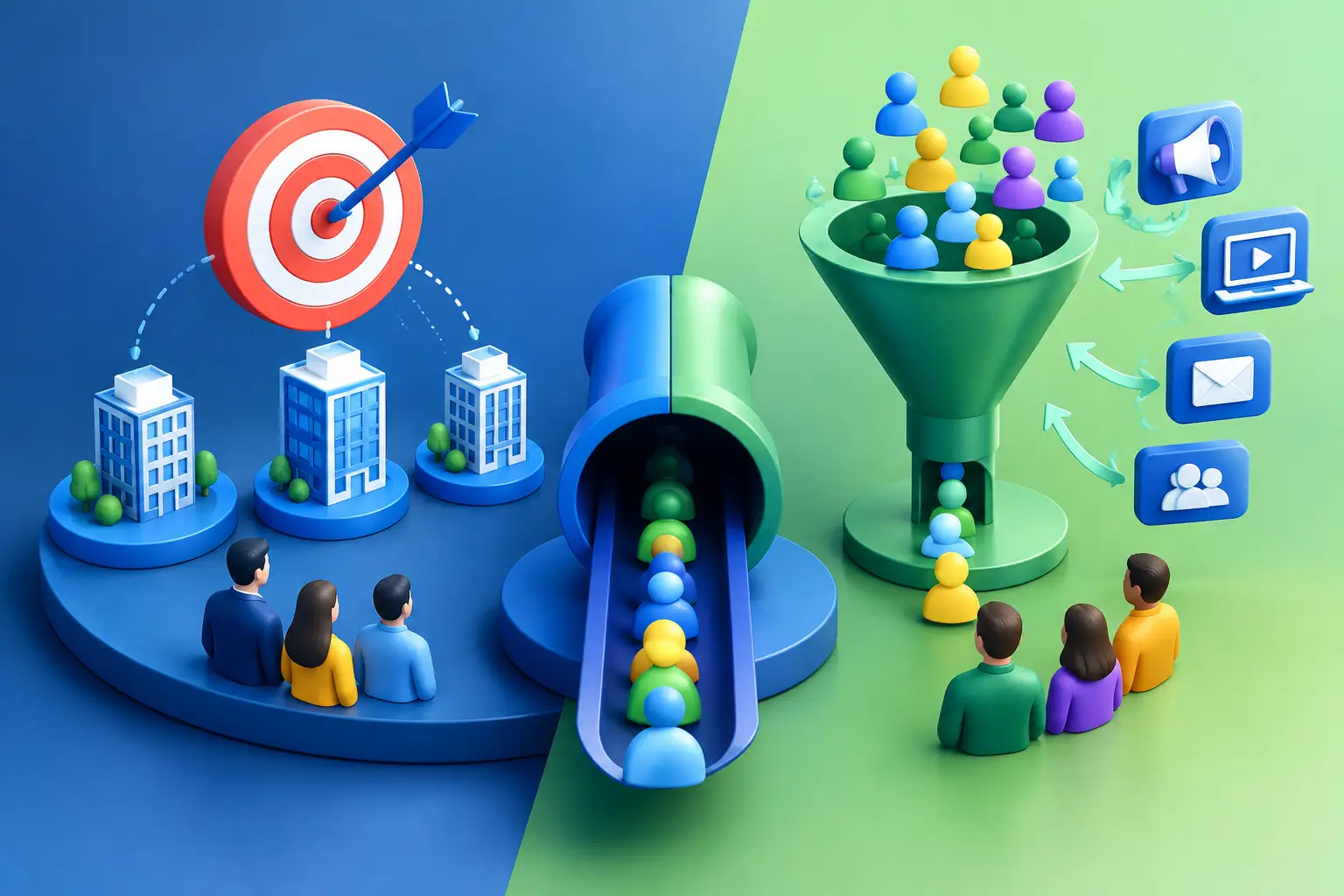
A VP of Sales with a $1 million enterprise pipeline gap does not need more anonymous ebook downloads. They need conversations with the 40 accounts most likely to buy. That is where the ABM versus demand generation decision becomes practical: are you creating broad market interest, or concentrating resources on named companies your sales team is ready to pursue?
Both motions can create revenue. Both can waste money when disconnected from the ideal customer profile, sales capacity, and buying reality. The right choice depends less on which approach is more sophisticated and more on how your company wins, who must be involved in the purchase, and how much precision your pipeline target requires.
ABM versus demand generation: the core difference
Demand generation creates awareness and captures interest across a defined market. Its goal is to make more relevant buyers aware of a problem, a category, or a solution, then convert that interest into leads, opportunities, and revenue. Typical programs include content, paid media, webinars, events, SEO, partner campaigns, and broad outbound campaigns segmented by persona or industry.
Account-based marketing, or ABM, starts from a smaller universe. Marketing and sales agree on specific companies, research their business context, map likely stakeholders, and coordinate messaging and outreach around the account. The objective is not simply to generate a lead. It is to create engagement inside a target account and move the buying group toward a qualified sales conversation.
The distinction matters because a form fill from an individual and meaningful engagement from a buying committee are not the same signal. For a mid-market or enterprise deal, one interested manager rarely equals a real opportunity. You may need a budget owner, technical evaluator, business champion, procurement contact, and executive sponsor. ABM is built for that complexity.
Demand generation is built for reach. It helps a company learn which messages attract a market, build future pipeline, and create a reliable flow of interest beyond the accounts sales already knows. It is especially useful when the total addressable market is large, the offer is easy to explain, or the sales cycle can begin with one engaged buyer.
When demand generation is the better first move
Demand generation earns its place when your company needs category visibility, message validation, or more top-of-funnel volume. A growing SaaS company launching a clear product for a broad operational problem may need to reach thousands of potential buyers before it knows which verticals, job titles, and pain points convert best.
It also works well when there is enough inbound intent to process. If your team can turn webinar attendance, high-intent content consumption, trial activity, or paid-search conversions into timely follow-up, demand generation can create efficient pipeline. The key word is timely. A lead that waits three days for a response is not a lead being actively generated. It is demand being allowed to cool.
The trade-off is precision. Broad programs often report healthy lead counts while sales sees little movement in qualified opportunities. This happens when the targeting is too loose, the conversion offer is too easy to access, or marketing measures activity without a clear qualification standard.
Before scaling demand generation, define what happens after someone engages. Who contacts them? How quickly? What makes them a sales-accepted lead? Which signals indicate a real project rather than casual research? Without those answers, more volume usually means more noise for the sales team.
When ABM deserves the investment
ABM is the stronger motion when account quality matters more than contact quantity. This is common for companies selling complex software, specialized services, security solutions, data infrastructure, consulting, or other offerings with meaningful contract values and multiple decision-makers.
Consider a company selling a $150,000 annual platform to regional financial institutions. There may only be 300 realistic prospects in its best market. Running a generic campaign designed to produce hundreds of leads makes little sense. The business needs a disciplined account plan: identify the institutions with the right size, technology environment, strategic trigger, and likely budget; then engage the leaders who can influence a purchase.
That does not mean every account requires a custom microsite and a six-month marketing production cycle. Many teams overcomplicate ABM and call it personalization. Effective ABM can begin with a tiered approach. The highest-value accounts receive deeper research, tailored messaging, and coordinated outreach. The next tier receives relevant industry or use-case campaigns. The broader target list receives focused outbound and demand programs based on the same ICP.
ABM works when the account list is credible, the sales team follows through, and outreach reflects a real point of view. It fails when teams label a static list of logos as strategy, send superficial personalization, or target accounts that have no plausible reason to change.
ABM needs sales and marketing to share the same scoreboard
ABM exposes misalignment quickly. Marketing cannot claim success because impressions increased if sales says the engaged accounts are wrong. Sales cannot reject every response without explaining why the account or contact missed the mark.
The shared scoreboard should center on account progression: target accounts researched, buying groups mapped, accounts engaged, qualified meetings booked, opportunities created, pipeline influenced, and closed revenue. These are not vanity metrics. They show whether the motion is producing access to companies that can actually buy.
For outbound-led ABM, meeting quality deserves special attention. A booked meeting is only valuable when it matches the ICP, includes a relevant stakeholder, has a defined business problem or strategic trigger, and has a reasonable path to a next step. Calendar volume without qualification creates a false sense of momentum.
The better question: what does your revenue model require?
The ABM versus demand generation debate becomes unhelpful when it is framed as an either-or decision. Most B2B companies need both. The strategic question is which motion should lead and where each one belongs in the revenue engine.
Let deal economics guide the answer. Higher contract values, longer buying cycles, narrower markets, and larger buying committees justify more account-level investment. Shorter sales cycles, broader addressable markets, lower deal values, and self-directed buyer behavior generally support a greater emphasis on demand generation.
Your stage also matters. An early-stage company may use demand generation to test positioning while running targeted outbound into a small set of high-potential accounts. A later-stage company with a proven ICP may use ABM to expand within strategic segments while demand generation sustains awareness and fills future pipeline.
Market conditions matter too. If buyers are not actively searching for your category, waiting for inbound demand can limit growth. Account-based outbound creates opportunities by putting a relevant commercial hypothesis in front of companies that fit. If buyers already search for your solution at meaningful volume, demand capture becomes more valuable and should not be neglected.
Build one coordinated pipeline system
The strongest go-to-market teams do not run ABM and demand generation as separate departments competing for budget. They use demand programs to create market intelligence and account programs to turn that intelligence into focused action.
For example, a demand campaign may reveal that operations leaders at multi-location service businesses respond strongly to a message about reducing manual workflows. That insight should shape the ABM account list, outbound copy, call talk tracks, and executive follow-up. Likewise, objections surfaced in outbound conversations should improve content, landing pages, and paid messaging.
Operational discipline makes the difference. Start with a defined ICP and a list of disqualifiers. Set clear account tiers. Establish contact and account-level qualification criteria. Build messaging around business triggers rather than generic product claims. Then create a feedback loop between the people generating engagement and the people closing deals.
An embedded outbound team can make this coordination practical for lean revenue organizations. Instead of handing sales a spreadsheet of contacts, the team can research accounts, test messages, run multichannel outreach, qualify responses, report on account-level signals, and book conversations that meet an agreed standard. That creates visibility into what is working before budget is committed to more scale.
Measure the cost of attention, not just the cost per lead
A low cost per lead can hide an expensive revenue motion. If 500 leads produce five sales conversations and one is remotely qualified, the campaign did not become efficient because the spreadsheet grew. Similarly, an ABM program can look costly on a per-account basis while delivering exceptional returns if it creates access to a small number of high-value opportunities.
Evaluate both approaches against pipeline quality and conversion economics. Look at the percentage of target accounts reached, engagement across the buying group, meetings that advance, opportunity creation, sales-cycle velocity, win rate, and pipeline value relative to program cost. These metrics make it easier to shift investment based on evidence rather than internal preference.
If your next growth target depends on a specific set of companies, begin with account precision and build demand around the insight you gain. If you need to learn where your market responds, create demand deliberately, then let the data tell you which accounts deserve a more focused pursuit. The useful answer is not choosing a side. It is building the motion that gives your sales team the right conversations to win.