

A new outbound campaign can fail before the first email goes out. Not because the copy is weak or the BDR lacks effort, but because the team confused AI prospecting versus research. They built a large list when they needed buying signals. Or they spent days researching individual accounts when they needed a faster way to find the right market.
For growth-stage B2B companies, this distinction matters because outbound capacity is finite. Every hour spent building a list, validating an account, writing a message, or chasing a reply has to contribute to qualified meetings. AI can dramatically increase that capacity, but only when it is assigned to the right part of the process.
AI Prospecting Versus Research: The Real Difference
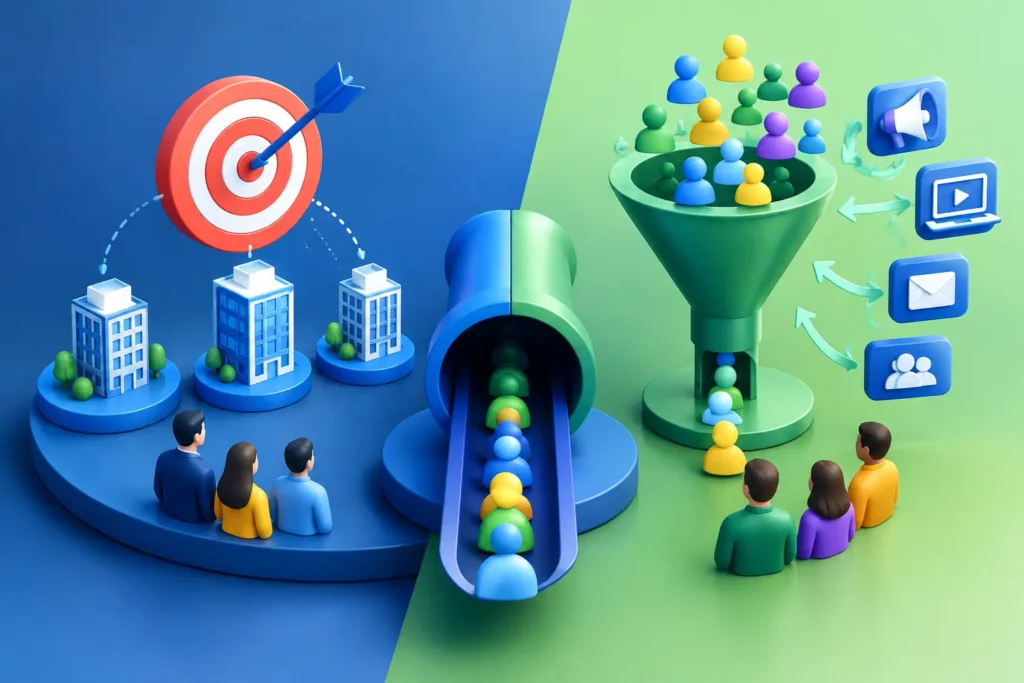
AI prospecting is the work of finding and organizing possible buyers at scale. It helps a team identify companies that resemble an ideal customer profile, locate relevant contacts, enrich firmographic data, spot basic triggers, and prioritize records for outreach. Its job is coverage. A prospecting workflow answers: Who should be on our radar?
Research is the work of understanding why a specific account or person may care now. It examines the company’s business model, growth priorities, leadership changes, current technology, recent initiatives, market position, and likely pain points. Its job is relevance. A research workflow answers: Why should this prospect take this conversation?
The distinction sounds simple, yet it is where many outbound programs lose momentum. Teams often expect AI to produce fully qualified opportunities from a prompt. It cannot reliably do that. It can surface candidates and summarize public information quickly. It cannot, on its own, determine whether a target account has a real problem, a realistic path to purchase, or a compelling reason to respond to your message.
On the other side, research-heavy teams can become too selective too early. A BDR may spend 20 minutes investigating an account that never belonged in the target market. That feels personalized, but it is expensive personalization applied to a poor-fit prospect.
Where AI Prospecting Creates Leverage
AI is especially useful when the challenge is market coverage. A company entering a new vertical, expanding into a new US region, or testing a new buyer persona needs a structured universe of accounts before it needs deep account narratives.
A well-designed AI prospecting workflow can help a team define account criteria, identify companies that meet those criteria, find the most relevant contacts, remove obvious duplicates, and organize prospects by segment. It can also flag signals such as hiring activity, funding events, technology changes, geographic expansion, or executive moves.
That is meaningful leverage, particularly for lean revenue teams. Instead of asking a sales leader or BDR to manually collect hundreds of records, AI can create a workable starting point in hours. The team can then spend its time on decisions that require judgment: whether the segment is commercially attractive, whether the contacts have influence, and whether the offer solves a problem those buyers recognize.
But volume is not qualification. A list with accurate titles and complete data can still be strategically wrong. If the target market is vague, the AI will efficiently return a vague market. If the ICP is based on assumptions, automation will scale those assumptions.
Start with an ICP that can survive contact with the market
Before activating any prospecting tool, establish the operating constraints. Define the company size, industry, geography, business model, buying roles, disqualifiers, and likely use cases. Clarify where the product wins, where it loses, and what event makes the pain urgent enough to discuss.
This is not an academic exercise. It determines whether your outbound team targets 500 accounts with a credible reason to engage or 5,000 accounts that look plausible in a spreadsheet. The better the inputs, the more useful AI prospecting becomes.
Where Research Protects Meeting Quality
Research begins after an account is identified as a plausible fit. It turns a name on a list into a point of view.
For complex B2B products and services, generic personalization is rarely enough. Mentioning a prospect’s LinkedIn post or company anniversary may prove that someone looked them up, but it does not establish commercial relevance. Strong research connects an observable business condition to a specific, credible hypothesis about value.
For example, a SaaS company hiring enterprise account executives may be preparing to move upmarket. A specialized services firm opening a new office may be pursuing a different client profile. A business that recently launched a new product category may need to create pipeline in a market where its brand is not yet established. None of these facts guarantees a meeting. They give the outbound team a reason to ask a sharper question.
AI can accelerate this stage by collecting public context and creating concise account briefs. A human should still verify the details and decide what belongs in the message. Public data can be outdated. A job posting may reflect routine backfill. A press release may be a weak signal dressed up as a strategic shift.
The standard is not whether a message sounds personalized. The standard is whether the outreach makes a relevant business hypothesis that a qualified buyer would recognize as worth discussing.
Build a Two-Speed Outbound Process
The strongest outbound engines do not choose between scale and relevance. They operate at two speeds.
The first speed is broad and disciplined. AI helps generate, enrich, segment, and score accounts against the ICP. The goal is to create enough market coverage to produce learning and pipeline without wasting BDR time on manual list building.
The second speed is selective and human-led. The team researches high-priority accounts, validates triggers, develops a message angle, and chooses the right channel mix. This is where cold email, LinkedIn outreach, and calls become coordinated outreach rather than disconnected activity.
Not every prospect deserves the same research investment. A named-account strategy for enterprise buyers may justify deeper investigation before the first touch. A mid-market campaign with a proven offer may start with lighter personalization and reserve deeper research for engaged accounts. It depends on deal size, sales cycle, addressable market, and how much differentiation the buyer can see without a conversation.
A practical model is to assign research depth based on account value and intent. High-value accounts with clear signals receive custom hypotheses and executive-level messaging. Strong ICP fits with limited signals receive segment-specific outreach. Lower-priority accounts remain in the prospecting pool until a trigger or engagement signal justifies more attention.
Common Failure Modes to Avoid
The most expensive mistakes happen when teams measure activity instead of commercial progress.
First, do not let AI-generated summaries become accepted truth. Require a BDR, campaign manager, or GTM leader to verify the details that drive the message. One inaccurate claim can damage credibility with an account you may want to pursue for years.
Second, avoid using research as a substitute for positioning. No amount of account detail can rescue an offer that is unclear, undifferentiated, or disconnected from the buyer’s priorities. If responses are consistently weak across a well-qualified segment, revisit the market message before researching more deeply.
Third, resist measuring prospecting by records added to a database. Track the movement from targeted accounts to conversations, qualified meetings, pipeline, and closed revenue. A smaller account list that produces real sales opportunities is more valuable than a large list that produces reporting theater.
Finally, do not treat follow-up as an afterthought. Research often becomes more valuable after the first touch. A reply, a profile view, a call outcome, or a new company announcement can change the message angle. Mature outbound programs use those signals to improve the next interaction rather than sending the same sequence on repeat.
Measure the Handoff, Not Just the Steps
Prospecting and research should work as one connected system. The handoff between them is where accountability lives.
Review which AI-sourced segments generate positive replies, which research angles create meetings, and which meetings advance into legitimate sales opportunities. Then feed that information back into the ICP, account scoring, message framework, and qualification criteria.
This operating loop is why an embedded outbound function can outperform a disconnected list vendor. At Oppify, prospecting, GTM engineering, US-based BDR execution, and reporting are treated as connected responsibilities. The aim is not to deliver more contacts. It is to create a repeatable path from market selection to qualified conversations.
The useful question is not whether AI can replace research. It is where automation creates speed without reducing judgment. Let AI handle the work that expands coverage and organizes information. Put experienced people on the work that determines relevance, earns trust, and qualifies opportunity. That is how outbound becomes a controlled pipeline engine instead of a high-volume guessing game.