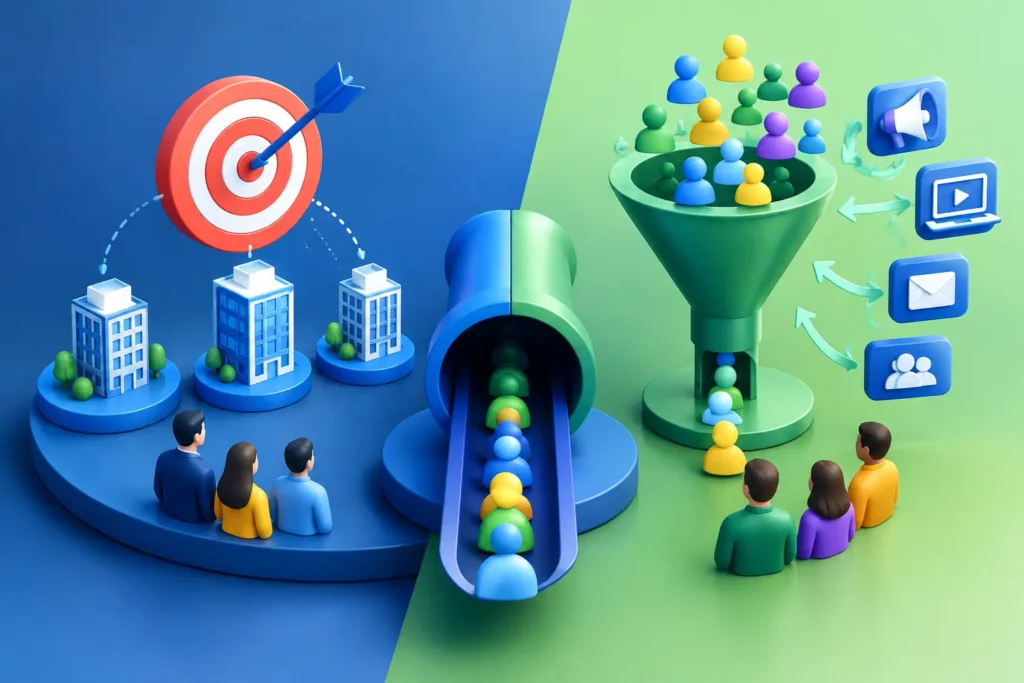


A pipeline problem can look like an outreach problem when it is actually an audience problem. This ICP refinement case study follows a familiar pattern: a B2B company had enough contacts, enough activity, and enough interest signals to keep its calendar moving, but too few meetings were becoming legitimate opportunities.
The issue was not effort. The team was targeting a broad market category, using credible messaging, and speaking with senior buyers. But the accounts that replied most often were not consistently the accounts most likely to buy, implement quickly, or expand over time.
That distinction matters. More replies can make an outbound program look healthy while sales absorbs the cost of unqualified discovery calls, weak handoffs, and deals that stall after the first conversation. ICP refinement is how a company replaces volume-driven activity with a more deliberate path to pipeline.
The starting point: a broad market, uneven pipeline
The company in this case sold a complex B2B service with a meaningful implementation component. Its offer could serve several industries, company sizes, and operational models. That flexibility created a common go-to-market mistake: the ICP became a list of companies that could use the product instead of companies most likely to buy it now.
Initial outbound campaigns targeted firms within a wide employee range, across multiple adjacent verticals, with senior operations, revenue, and technology leaders all included as potential buyers. The campaigns generated conversations. The problem emerged after booking.
Some prospects had no active business trigger. Others had a use case but lacked budget ownership or internal urgency. A third group had the right executive title but worked in companies too small to support the sales motion. Meetings were not worthless, but they required substantial seller education and rarely progressed on the expected timeline.
The leadership team did not need another generic lead list. It needed clarity on which account conditions, buyer roles, and pain signals were creating real sales momentum.
What the ICP refinement case study measured
Refining an ICP should not start with firmographic assumptions alone. Industry, headcount, and revenue bands are useful filters, but they are rarely enough for complex B2B sales. A strong ICP connects account characteristics to buying conditions.
The team reviewed recent opportunities, including closed-won deals, active late-stage opportunities, early-stage opportunities, and meetings that went nowhere. The goal was not to find a single attribute shared by every customer. It was to identify the combinations that appeared most often in deals with a credible path to revenue.
Three areas produced the clearest signal.
1. Operational complexity mattered more than industry labels
The first finding was that the best opportunities did not come from one industry alone. They came from companies facing a specific operational condition that made the offer more valuable and more urgent.
For example, companies with distributed teams, a growing customer base, or an expanding market footprint had a stronger reason to evaluate the service than similar-sized businesses with stable, simple operations. The original targeting model had treated these companies as equivalent because they shared an industry code and employee range. They were not equivalent in practice.
This changed account research. Instead of asking only, “Does this company fit our vertical?” the team asked, “Is this company operating in a way that makes the cost of inaction visible?”
2. The economic buyer and daily user needed separate messaging
The original campaign often used one message for several senior titles. That created a predictable problem: a message that was broad enough for everyone was specific enough for no one.
The refined model separated the people who felt the problem from the people who approved the investment. Operational leaders cared about workload, execution risk, and process breakdowns. Revenue and executive leaders cared about growth constraints, cost control, forecast confidence, and speed to impact.
Both audiences mattered, but they needed different reasons to respond. The campaign structure reflected that difference while maintaining a shared commercial narrative. This also made qualification more reliable because BDRs could identify whether an engaged contact was a champion, evaluator, budget owner, or useful path to the buying committee.
3. Trigger events separated active buyers from passive fits
The most valuable change was adding triggers to the ICP. A company can be an excellent long-term fit and still be a poor outbound prospect this quarter. Without a trigger, even a well-researched message may land before the problem has become a priority.
The refined ICP prioritized accounts showing signs of change: hiring in relevant functions, leadership transitions, geographic expansion, new product launches, technology changes, funding events, or public signals of increased operational pressure. Not every trigger was equally meaningful, so the team scored them against historical opportunity quality.
This was not a reason to ignore companies without visible triggers. It was a reason to separate active outreach tiers from nurture tiers. High-fit accounts with current pressure received the most personalized outreach and calling effort. High-fit accounts without a clear catalyst remained in the market but followed a lower-intensity cadence.
Turning the refined ICP into an outbound system
A refined ICP only works when it changes execution. If the sales team agrees on the profile but the contact database, sequences, calling priorities, and meeting criteria stay the same, the program will produce the same mixed results.
The team rebuilt the account universe into distinct segments. The highest-priority segment required the right company profile, the operational condition, and an observable trigger. A second segment included accounts with strong profile alignment but less immediate evidence of urgency. Lower-priority segments were retained only when there was a defensible reason to test them.
Each segment received a different outreach approach. The top tier got deeper account research, role-specific messaging, multichannel touches, and direct BDR follow-up. The second tier used a lighter campaign designed to create awareness and identify timing. This protected BDR capacity for the accounts most likely to warrant a serious sales conversation.
Meeting qualification also changed. A booked meeting was no longer counted as a success simply because a senior prospect accepted. The BDR team captured the business problem, current approach, relevant timing, likely stakeholders, and next-step intent before the meeting was treated as qualified.
That standard can reduce raw meeting volume at first. It should. A calendar filled with polite but non-actionable conversations is not pipeline generation. It is a scheduling service.
Results: fewer false positives, stronger sales conversations
The refined approach improved the quality of engagement before it improved volume. Reply rates became less meaningful as a primary scorecard because the team cared more about who replied and why.
Sales reported that first meetings had more context. Prospects recognized the problem being discussed, could explain why it mattered internally, and were more likely to involve the right stakeholders in a second conversation. The handoff from BDR to account executive became cleaner because account research and qualification notes reflected the actual buying situation rather than a generic interest statement.
The program also created better visibility into where the ICP was still too broad. Some segments continued to create engagement but failed to produce qualified follow-up. Instead of defending those segments because they generated activity, the team reduced their priority and reinvested effort in the patterns associated with progressing deals.
That feedback loop is the point. ICP refinement is not a one-time positioning workshop. It is an operating discipline connecting prospecting, messaging, calls, qualification, and opportunity outcomes.
The trade-off: narrower does not always mean smaller
Leaders sometimes resist narrowing their ICP because they worry about shrinking TAM. That concern is valid when a company has a limited market or a product that depends on broad adoption. But an outbound ICP is not the same as the total addressable market.
Your TAM can remain broad while the accounts receiving concentrated outbound investment become more selective. The question is not whether other companies could eventually buy. The question is where your team can create the most qualified conversations with the time, data, and BDR capacity available.
For early-stage companies, the right ICP may need to stay somewhat flexible while product-market fit is still being tested. For growth-stage companies, the cost of flexibility rises quickly. Once a sales team needs repeatable pipeline, vague qualification standards become expensive.
Oppify approaches this work as part of the outbound engine, not a slide deck delivered before execution begins. Account selection, messaging, calling, qualification, reporting, and iteration all need to reflect the same definition of a high-value prospect.
The practical test is simple: after a prospect books, can your sales team explain why this account is likely to buy, who needs to be involved, what has changed, and what happens if the problem remains unresolved? If the answer is unclear, the next improvement is not more outreach. It is a sharper ICP.