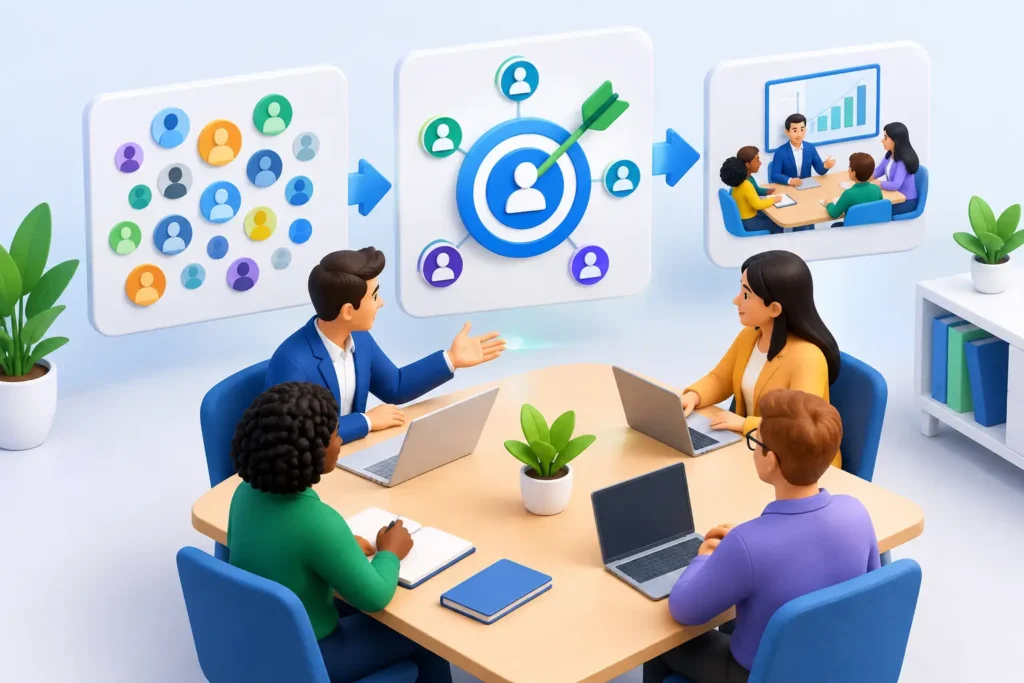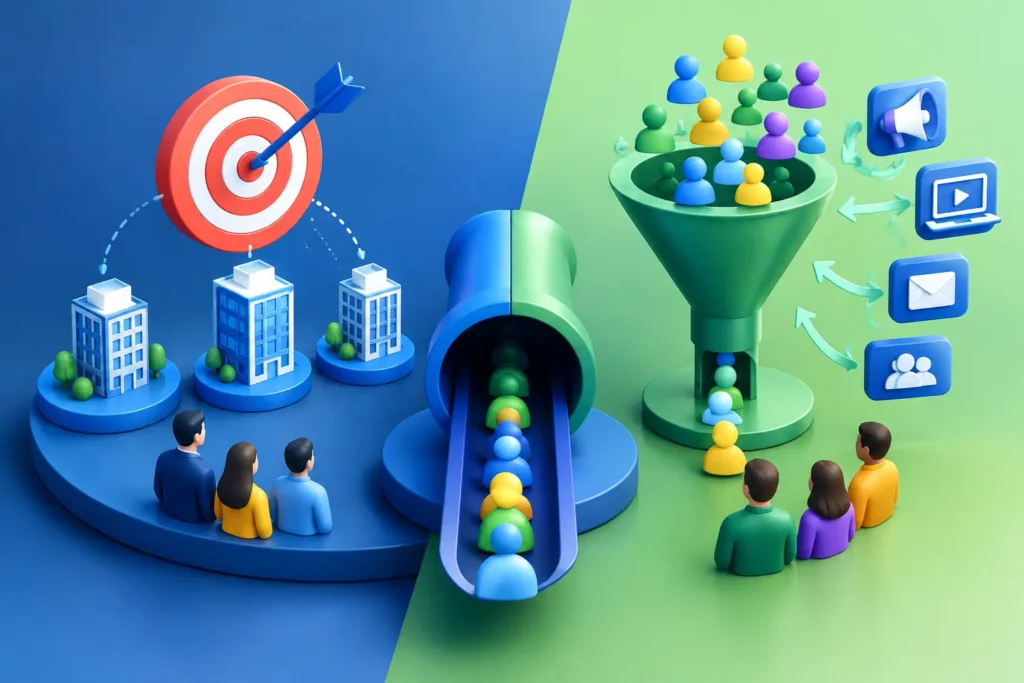


A BDR team does not fail because reps lack activity. It fails because activity is disconnected from a clear commercial system. To build a BDR playbook that creates pipeline, define who the team should pursue, what problem it can credibly lead with, how each channel works together, and what happens after a prospect responds.
For lean B2B teams, this is not documentation for documentation’s sake. A useful playbook reduces ramp time, protects message quality, exposes funnel problems early, and gives leadership a direct view of whether outbound is producing qualified opportunities rather than inflated activity metrics.
Start With Revenue Goals, Not Outreach Volume
Most outbound plans begin with a target number of emails or calls. That is backwards. Begin with the revenue outcome: how much pipeline is required, how many opportunities are needed to produce it, and how many qualified first meetings are necessary to create those opportunities.
Work backward using your actual conversion data where possible. If your sales team converts 25% of qualified first meetings into opportunities and 20% of opportunities into closed-won business, a goal of 10 new customers requires 200 qualified meetings. If the business is entering a new market, use conservative assumptions until enough data exists to replace them.
This exercise creates the operating targets for the BDR function: meetings held, sales-accepted opportunities, pipeline created, and revenue influenced. Emails sent and dials completed still matter, but only as diagnostic metrics. High activity with low meeting quality is not a BDR success story. It is a targeting, message, or qualification problem.
Define an ICP That a BDR Can Actually Use
An ideal customer profile cannot stop at firmographics such as industry, employee count, and revenue. Those filters are useful for building a list, but they do not tell a BDR why an account should care now.
A functional ICP includes account traits, buying signals, likely pain, relevant stakeholders, and clear disqualifiers. For example, a cybersecurity platform may target mid-market financial services firms with distributed workforces, recent compliance pressure, and a lean security team. A BDR should also know when not to pursue an account, such as when the company already uses a deeply embedded competitor, lacks the required infrastructure, or sits below the minimum contract value.
Turn account research into point-of-view research
The best outbound campaigns do not merely mention a prospect’s company name. They connect an observable business condition to a credible reason for a conversation.
Give BDRs research prompts that are specific enough to be repeatable. They might look for hiring patterns, product launches, geographic expansion, technology changes, funding events, leadership priorities, public customer commitments, or compliance deadlines. The signal itself is not the message. The BDR must translate it into a relevant hypothesis about risk, cost, growth, or operational friction.
This is where human judgment matters. AI can accelerate account research, organize data, and support workflow automation. It should not be left alone to decide whether a generic trigger is meaningful to a complex buyer.
Build Messaging Around Problems You Can Prove
Your playbook needs more than approved email templates. It needs a messaging architecture that helps BDRs adapt without improvising the core value proposition on every call.
Start with two or three pain-led campaign themes. Each theme should identify the business problem, who feels it most, the cost of leaving it unresolved, and the proof behind your approach. The proof may come from customer outcomes, implementation experience, a differentiated process, or a distinct category insight.
For each theme, document the opening hypothesis, the questions a BDR can ask, common objections, and the appropriate proof point. This keeps messaging relevant across email, LinkedIn, and cold calls without making every touch sound copied and pasted.
Personalization should earn attention, not become a research performance. Mentioning a recent announcement only works when it supports the reason for reaching out. If there is no credible connection between the observation and your offer, use a sharper industry or role-based insight instead.
Design the Multichannel Sequence
A playbook should define how channels work together, not treat email, LinkedIn, and calling as separate programs. Different buyers respond to different channels, and complex sales often require repeated, credible exposure before a prospect engages.
A typical sequence may include an initial email built around a specific hypothesis, a LinkedIn connection or engagement touch, a call attempt, a follow-up that adds proof or a new angle, and a final close-the-loop message. The exact cadence depends on the audience. Senior executives may require fewer, more thoughtful touches. Operational buyers with a clear pain point may justify a more persistent calling motion.
Document the purpose of every touch. Do not send five versions of the same message. One email can establish relevance, a call can test urgency, and a later email can address a likely objection or offer a concrete asset. If a prospect opens repeatedly but does not respond, that may signal message interest but insufficient call-to-action clarity. If calls connect but conversations end quickly, the opener may be weak or the account may be poorly qualified.
Set Qualification Rules Before Meetings Hit the Calendar
Booked meetings are only valuable when the sales team sees a credible path to revenue. The playbook should define what counts as qualified in language both BDRs and account executives accept.
Qualification criteria will vary by company, but usually include ICP fit, a relevant business problem, a role with influence or access to the buying group, and an agreed reason to continue the conversation. Budget and timing matter, but requiring a fully formed budget before a first conversation can eliminate early-stage opportunities that deserve sales attention.
Make the handoff explicit. The BDR should capture the prospect’s stated problem, current approach, trigger event, relevant stakeholders, meeting objective, and any risks raised in the conversation. The account executive should know what was promised and what the buyer expects next.
A meeting that no-shows or is disqualified is not wasted if the reason is recorded. These outcomes sharpen targeting and message decisions. They become waste only when the team treats them as isolated events instead of funnel data.
Create Operating Standards for Reps and Leaders
A BDR playbook is an operating system, so it needs clear ownership. Define daily activity expectations, research standards, CRM fields, follow-up service levels, call-review routines, and escalation paths for strategic accounts.
Reps need enough structure to execute consistently and enough room to use judgment. Overly rigid scripts create generic outreach. Loose guidance creates inconsistent positioning and reporting that cannot be trusted. The right balance is a defined process with controlled flexibility: approved campaign themes, required account context, and room to select the most relevant angle.
Leaders should review a small set of leading and lagging indicators every week. Leading indicators include account coverage, contact quality, sequence completion, call connects, and positive reply rates. Lagging indicators include meetings held, sales acceptance, opportunity conversion, pipeline created, and closed-won revenue.
The critical question is not, “Did the BDRs work hard?” It is, “Where is the funnel breaking, and what will we change this week?”
Treat the Playbook as a Testing System
The first version of your playbook is a hypothesis, not a finished asset. Markets shift, segments behave differently, and a message that works for a VP of Sales may fail with a COO or technical buyer.
Run controlled tests with enough volume to learn something useful. Test one meaningful variable at a time: a campaign angle, persona, proof point, call opener, or offer. Avoid changing the list, sequence, message, and qualification criteria simultaneously. You may get a result, but you will not know what caused it.
Report findings in commercial terms. A subject line test that lifts open rates but produces fewer qualified conversations is not a win. A narrower segment that generates fewer meetings but higher sales acceptance may be worth scaling. This is why outbound requires GTM engineering as much as it requires rep effort.
For companies without the time or headcount to build all of this internally, an embedded outbound team can provide the leadership, enablement, workflow infrastructure, and US-based BDR execution needed to put the model into production. Oppify operates on that premise: the outbound function should be accountable for creating qualified conversations, not simply delivering a list of leads.
The most useful playbook gives your team a repeatable way to learn. When targeting, messaging, qualification, and follow-up improve together, outbound stops being a gamble on rep activity and becomes a managed source of pipeline.