

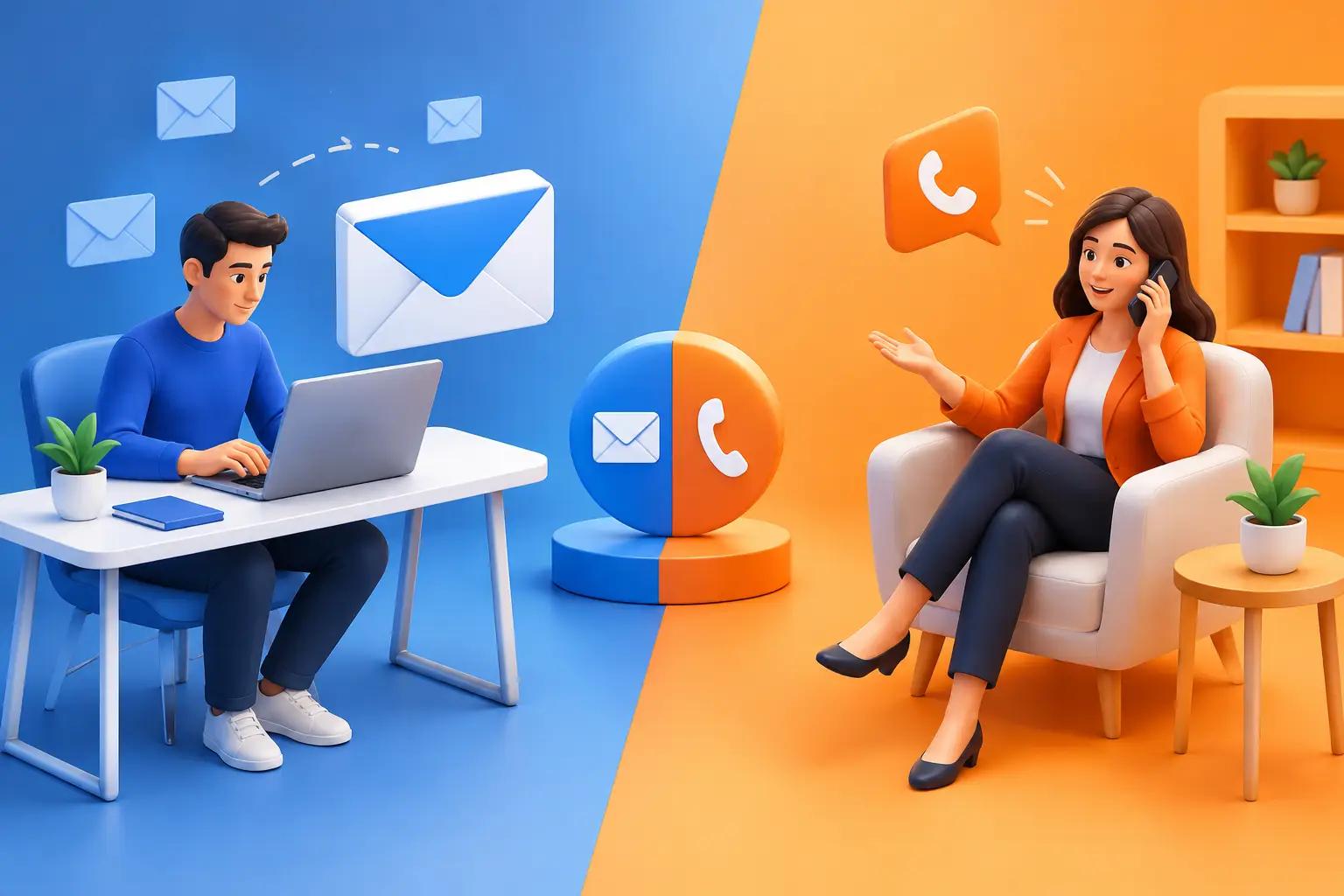
A CFO who ignores five emails may still answer an unfamiliar call between meetings. A VP of Engineering who never picks up a number they do not recognize may read a concise email at 10:30 p.m. Neither behavior makes one channel universally better. It makes the cold email versus cold calling decision a go-to-market design question.
For B2B companies selling complex products and services, the objective is not activity volume. It is earning a relevant conversation with the right account, at the right time, with enough context to justify a first meeting. Email and calling play different roles in that process. The teams that generate predictable pipeline do not treat them as competing tactics. They use each channel where it has the highest leverage.
Cold email versus cold calling: the real trade-off
Cold email creates asynchronous access. A prospect can evaluate your relevance without being forced into a live conversation. It is efficient for reaching a broad, tightly defined account list, testing positioning, and delivering a personalized point of view at scale. It also creates a written trail that can be forwarded internally, revisited before a meeting, or surfaced when a buying trigger appears.
Cold calling creates immediacy. When a prospect answers, a capable BDR can validate assumptions, navigate objections, and learn details that rarely appear in a reply. A 90-second conversation can reveal whether an account is already solving the problem, who owns the initiative, when a contract renews, or why a seemingly ideal prospect is not a real opportunity.
The trade-off is simple. Email is easier to scale but easier to ignore. Calling earns faster feedback but requires stronger execution, better timing, and the resilience to work through far more rejection. Neither channel compensates for a weak ideal customer profile, generic messaging, or poor qualification.
A company with a narrow market and a high contract value should not decide based on the cheapest cost per touch. If one qualified meeting can become a six-figure customer, a disciplined calling motion may justify its labor intensity. If the offer serves a wider market with a straightforward pain point, email can efficiently identify engaged accounts before human time is applied.
Where cold email does its best work
Email is especially effective when your buyer needs context before they will engage. That is common in enterprise SaaS, cybersecurity, data infrastructure, professional services, and other categories where the prospect may not immediately understand the problem you solve.
A good cold email does not attempt to explain the full product. It proves the sender has a reason to contact that company now. That reason might be a hiring pattern, a new product launch, a market expansion, a technology change, a public initiative, or a gap in the account's current go-to-market approach. The message should connect that signal to a credible business outcome and ask for a small next step.
Email also helps teams operationalize learning. Subject lines, opening angles, buyer personas, account segments, and calls to action can be tested across a controlled audience. Reply data is useful, but the most valuable signal is not open rate or even positive reply rate. It is whether qualified prospects agree to meetings and whether those meetings advance to real pipeline.
There are limits. Deliverability is a serious operating discipline, not an afterthought. New domains, poor list hygiene, excessive volume, and templated copy can damage sender reputation quickly. A team that treats email as a mail merge exercise may generate activity while quietly losing access to the inbox.
Where cold calling creates an advantage
Cold calling is strongest when a live conversation can materially improve qualification or accelerate a deal. It works well when the value proposition is clear, the buyer is senior, and the target list is specific enough that each conversation is worth preparation.
The first call should not sound like a product tour delivered at high speed. The goal is to establish relevance, earn permission to ask a question, and determine whether there is a business reason to continue. A practical opener references the account, names the problem area, and gives the prospect room to say whether it is relevant.
For example, a BDR calling a VP of Sales at a company expanding into the US market may ask how the company is currently creating pipeline in a segment where it has limited brand recognition. That question is more productive than asking whether the prospect has “a few minutes to hear about our services.” It frames a commercial issue the buyer already understands.
Calling also gives outbound teams fast message-market feedback. If multiple prospects misunderstand the offer, object to the category, or say the timing is wrong for the same reason, leadership can adjust targeting and messaging before another thousand emails go out. Those conversations are market intelligence, not just call outcomes.
The downside is execution risk. Unprepared callers can damage credibility with senior buyers. Poor call notes create broken follow-up. And calling without a clear account strategy becomes a volume contest that burns BDR capacity without creating opportunities. The channel works when it is supported by research, coaching, clear qualification criteria, and a follow-up process that does not end after one voicemail.
The highest-performing motion uses both
For most complex B2B sales motions, the best answer is a coordinated multichannel sequence. Email creates familiarity and context. Calls create urgency and discovery. LinkedIn can reinforce legitimacy when used selectively. Each touch should build on the last rather than repeat the same generic pitch.
A prospect who receives a thoughtful email on Monday is not receiving a truly cold call on Wednesday. The caller can reference the business issue raised in the email and ask a focused question. If the prospect does not answer, the voicemail and follow-up email should add a useful detail, not simply say, “I tried calling.”
This approach is particularly effective for accounts with buying committees. One contact may respond to email, another may take the call, and a third may influence the evaluation later. A multichannel motion gives the outbound team more chances to map the account without treating every person as an isolated lead.
The sequence must still respect the buyer. More touches are not automatically better. If outreach offers no evidence of account relevance, frequency becomes noise. If each interaction introduces a new insight, validates a hypothesis, or makes the next step easier, persistence can feel professional rather than intrusive.
Choose the channel mix based on your sales motion
Your channel allocation should follow the economics and complexity of the sale. Consider four operating questions:
- How narrow is the ICP, and how costly is it to miss a high-value account?
- Does the buyer need written context before a conversation is likely?
- Can a live call uncover qualification details that materially affect conversion?
- Does your team have the data, coaching, and follow-up discipline to execute calls well?
If your answer points to a small number of strategic accounts, invest more human effort per account. Research the company, tailor the business case, coordinate email and calls, and document every signal. If you are entering a broader but well-defined segment, use email to test messages and identify engagement before prioritizing call time.
The key metric is not whether calls connect or emails receive replies. Measure qualified meetings held, sales-accepted opportunities, pipeline created, and revenue contribution by account segment and channel sequence. A channel that appears expensive at the top of the funnel may be highly efficient once opportunity quality is considered.
Build an outbound system, not a channel argument
The question is not whether your team should send emails or make calls. The question is whether you have a repeatable system for selecting accounts, identifying the right people, presenting a relevant point of view, qualifying interest, and following up until there is a clear outcome.
That system needs ownership. Someone must translate ICP decisions into lists, campaign themes into personalized messaging, engagement data into BDR priorities, and call feedback into better positioning. Fragmented tools and isolated activities do not create pipeline on their own.
Oppify approaches outbound as an embedded meeting-generation function because execution lives in those details: the account research, the channel coordination, the qualification standard, and the reporting loop. The goal is not to produce a dashboard full of touches. It is to put credible opportunities on the calendar for a sales team that needs to close revenue.
Start with a segment where your value is clearest, run both channels with a defined hypothesis, and inspect the quality of the conversations you create. The prospect who responds is useful. The prospect who tells you why they will not is useful too. Treat both as signals, and your next outreach cycle will be harder to ignore and easier to convert.