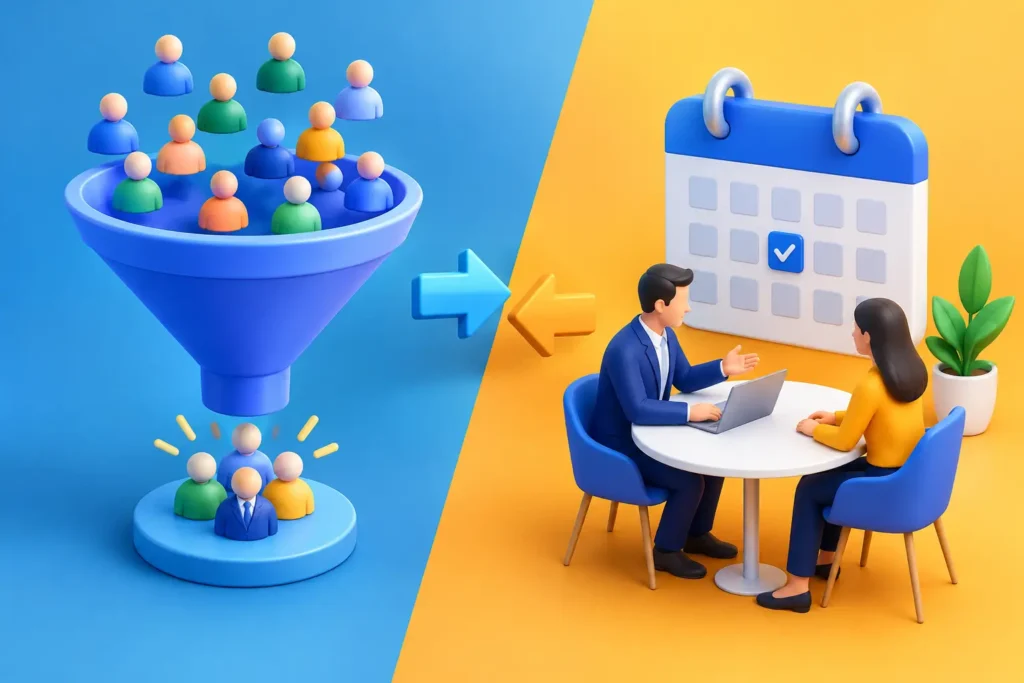


A new BDR hire can look like the obvious answer when pipeline is thin. Then the real work begins: defining the ICP, sourcing data, configuring systems, writing messaging, coaching calls, managing deliverability, and waiting through a ramp period that may not produce a single qualified meeting. The decision to outsource BDR versus hiring is not simply a headcount decision. It is a decision about how quickly your company can build a reliable outbound operating system.
For founders, CROs, and sales leaders with ambitious revenue targets, the right answer depends on the maturity of your go-to-market motion, the complexity of your sale, and the internal capacity available to manage execution. A BDR is valuable. A BDR without the surrounding infrastructure is often an expensive experiment.
Outsource BDR Versus Hiring: Start With the Real Job
Companies often compare an outsourced BDR partner to one internal BDR. That is the wrong comparison.
A productive outbound function requires more than someone sending emails and making calls. It needs account research, contact data, segmentation, messaging development, multichannel sequencing, CRM administration, inbox and domain management, call coaching, qualification standards, and reporting. Someone must also use campaign results to refine targeting and improve conversion over time.
When you hire internally, those responsibilities do not disappear. They are usually distributed across a sales leader, marketing, operations, and the new BDR. In a lean organization, that means the founder or VP of Sales often becomes the de facto outbound manager while still carrying closing, forecasting, and recruiting responsibilities.
An outsourced model should provide the function, not just labor. The strongest partners operate as an extension of your go-to-market team, bringing BDR execution together with leadership, enablement, prospecting technology, and campaign operations. Your closers remain focused on discovery, deal strategy, and revenue. The outbound team owns the work required to put qualified first meetings on the calendar.
The Cost Is Bigger Than Salary
The fully loaded cost of an internal BDR goes well beyond base compensation. Add variable pay, payroll taxes, benefits, recruiting time, onboarding, sales engagement tools, contact data, calling software, management overhead, and the cost of turnover. For a US-based BDR team, those expenses compound quickly.
The larger risk is paying for idle capacity during ramp. A new representative needs time to learn your product, buyer language, competitive positioning, qualification criteria, and sales process. If your ICP is still evolving, they may also spend months testing messages against the wrong accounts.
Outsourcing turns much of that fixed commitment into a more predictable operating expense. It can also remove the need to assemble a separate technology stack and train a manager to run it. That does not mean outsourcing is automatically cheaper in every scenario. If you already have experienced sales-development leadership, documented playbooks, mature data operations, and enough volume to support several BDRs, an internal team may achieve strong long-term economics.
But early-stage and growth-stage companies rarely begin with all of those conditions in place. They need pipeline now, not a six-month project to build the machinery that creates it.
Ramp Time Determines More Than Speed
Outbound is a compounding discipline. Better targeting improves replies. Better replies improve conversations. Better conversations reveal objections, which sharpen messaging and qualification. The faster you enter that learning cycle, the faster your pipeline becomes more predictable.
An internal hire starts at the beginning of that cycle. They need systems, lists, messaging, oversight, and feedback. Even a talented BDR can struggle if the underlying motion is unclear or the manager does not have time to coach consistently.
A capable outsourced team begins with established workflows. It should collaborate with your team to define target accounts and buying roles, build campaigns around real pain points, execute across email, LinkedIn, and calling, and report on what is working. This does not eliminate onboarding. Complex products and services require subject-matter input from the client. It does compress the operational setup required to begin testing the market.
Speed matters most when you are entering a new vertical, launching a new offer, validating a segment, or trying to create pipeline ahead of a fundraising milestone. In those moments, waiting to build an internal department can be more costly than the monthly budget line suggests.
Control Is a Valid Concern – But Define It Correctly
Sales leaders often hesitate to outsource because they fear losing control of brand messaging, prospect quality, or customer experience. That concern is justified when the vendor treats outbound as a volume game and measures success by activity alone.
Control should not mean personally approving every email or listening to every call. It should mean having clear visibility into who is being contacted, why they fit your ICP, what message they receive, how meetings are qualified, and what happens after a prospect responds.
A disciplined outsourced partner creates that visibility through shared reporting, defined qualification criteria, regular strategy reviews, and direct feedback loops with sales leadership. You should be able to see campaign activity, engagement patterns, meetings booked, conversion quality, and the adjustments being made.
The best outsourcing relationships are not hands-off. They are high-accountability partnerships. Your team supplies product expertise, deal feedback, and a fast response to booked meetings. The outbound team supplies execution, testing discipline, and the operational rigor to keep the funnel moving.
When Hiring Internally Is the Better Move
Hiring is the stronger choice when outbound is already a proven, well-documented engine inside your company. You have a clear ICP, reliable account and contact data, established messaging, capable BDR management, and enough sales volume to justify a dedicated team.
It can also be the right path when your motion requires unusually deep product knowledge before a meaningful first conversation can happen. Highly technical enterprise solutions, regulated categories, and narrow markets may demand a level of immersion that is best built internally over time.
Still, even in those cases, outsourcing can play a strategic role. An external team can help test a new market, cover a specific segment, create pipeline during a hiring gap, or establish the process that future internal hires will inherit. This is not always an either-or decision.
When Outsourcing Creates the Stronger Outcome
Outsourcing is especially useful when your sales team can close but lacks consistent top-of-funnel coverage. It fits companies that have a credible product and sales process but do not want to spend leadership time building a five-person outbound function from scratch.
It is also effective when the objective is focused and measurable: create qualified meetings in a new segment, fill pipeline for account executives, establish a repeatable outbound channel, or support a market-entry initiative. The engagement works best when both sides agree on the ICP, meeting definition, handoff process, and review cadence before campaigns launch.
Oppify approaches this as an embedded meeting-generation function, combining GTM leadership, enablement, prospecting workflows, and US-based BDR execution. The goal is not to deliver a spreadsheet of names. It is to create relevant conversations with accounts your sales team has a reason to win.
Make the Decision Based on Readiness, Not Preference
Before choosing a model, assess the work that exists beyond the BDR seat. Ask whether you have a documented ICP, validated messaging, clean data, functioning outbound infrastructure, a manager with time to coach, and a reliable process for following up on meetings. If several answers are no, you are not just hiring a representative. You are building a department.
If you have those capabilities and plan to scale a large, permanent sales-development organization, internal hiring may be the right investment. If you need qualified pipeline faster, want to protect leadership bandwidth, or need expert execution while your go-to-market motion develops, outsourcing can create a faster path to evidence and revenue.
Choose the model that gives your team the clearest line from target account to qualified conversation – then hold that model accountable for what happens next.