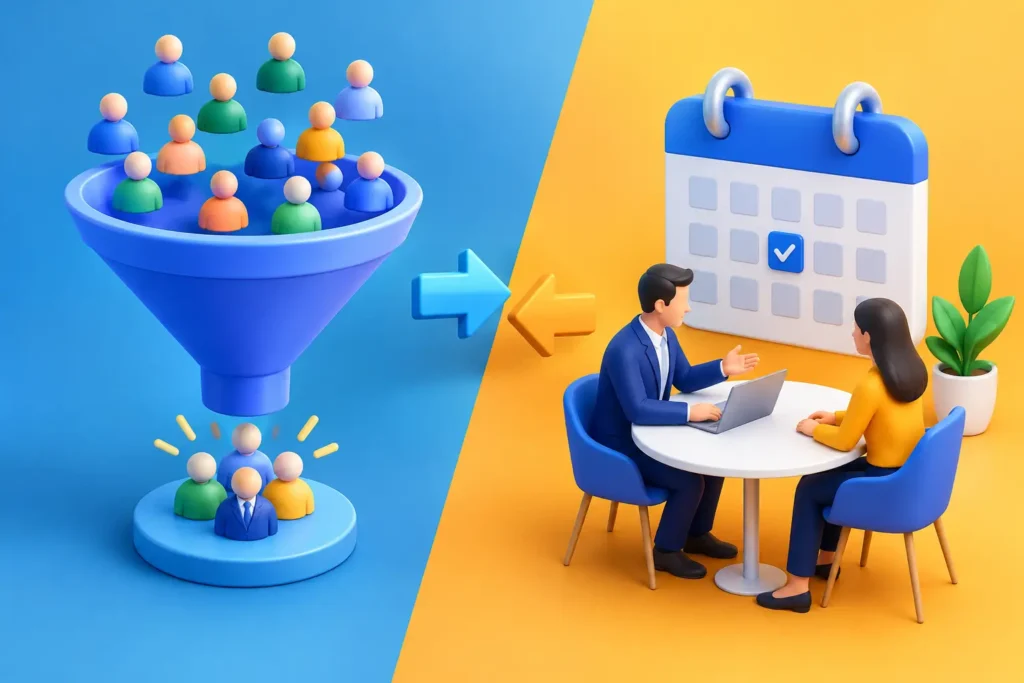


A founder can usually feel the outbound problem before it appears in a dashboard. Sales calls are inconsistent. AEs are prospecting between demos. The CRM has contacts, but no reliable process for turning the right accounts into qualified first meetings. That is often when startups outsource BDRs – not because outbound is optional, but because building it internally has become a distraction from closing revenue.
Outsourcing is not automatically the right move. If the offer is unclear, the ideal customer profile is untested, or the sales team cannot convert interest into opportunities, an external BDR team will only scale confusion. But when the fundamentals are in place, an embedded outbound function can create pipeline faster and with less operational risk than hiring, training, and managing a new internal team.
The real trigger is not headcount
Startups rarely outsource BDRs because they simply need more activity. They do it because revenue leadership needs a repeatable way to create conversations with a defined market while protecting internal capacity for discovery, demos, proposals, and closing.
The hiring math makes this clear. An internal BDR hire is not just a base salary. It includes recruiting time, onboarding, management, sales enablement, data providers, sequencing tools, calling infrastructure, deliverability operations, and the inevitable ramp period. One rep also creates a single point of failure. If that person leaves after six months, the company often starts over with the same training burden and a thin pipeline.
An outsourced model makes more sense when leadership needs the output of a coordinated function rather than the effort of one junior employee. Effective outbound requires strategy, account research, list building, messaging, multichannel execution, qualification, and disciplined follow-up. Those are different jobs, even when a small internal team asks one person to carry all of them.
When startups outsource BDRs with confidence
The strongest outsourcing decisions happen after a company has enough commercial clarity to direct the work. That does not mean every message is finalized or every segment is proven. It means the company can make informed choices, learn from the market, and act quickly on what the data shows.
Your ICP is clear enough to target
A startup does not need a perfect total addressable market model before beginning outbound. It does need a usable ICP. The team should be able to explain which companies are most likely to buy, which roles participate in the decision, what business event creates urgency, and why the product or service is worth changing the status quo.
For example, “mid-market SaaS companies” is too broad for a serious campaign. “US-based SaaS companies with 100 to 500 employees that are hiring enterprise sales teams and need better pipeline visibility” gives an outbound team something they can research, segment, and personalize around.
If the answer to “who should we contact first?” changes every week, pause before outsourcing. Use customer interviews, founder-led sales, and existing deal data to narrow the target. An experienced partner can help sharpen the ICP, but it cannot invent market fit.
Your sales team can handle qualified meetings
Outbound works only when the handoff works. If an AE receives a qualified meeting and waits three days to follow up, the meeting quality problem is not the BDR team. If discovery calls are weak, pricing is unclear, or proposals stall because no one owns next steps, more meetings will not fix the revenue engine.
Before engaging an outsourced BDR function, establish who owns every stage after the meeting is booked. Set response-time expectations. Define what qualifies as a sales-accepted opportunity. Make sure the closer has a clear discovery process and enough calendar capacity to pursue demand.
This is especially relevant for founder-led teams. Founders often close best because they know the product and customer pain deeply. But if every outbound meeting requires the founder and the founder is already overloaded, the company needs a plan for transferring that knowledge to sales before it scales acquisition.
You need speed, not a long hiring experiment
Hiring internally can be the right long-term choice for a mature company with a stable sales motion and experienced leadership. It is a slower choice for a startup entering a new segment, preparing for a funding milestone, or facing a pipeline gap this quarter.
An outsourced team brings established workflows, BDR management, prospecting tools, and campaign operations from day one. The goal is not to avoid accountability by handing work to a vendor. The goal is to reduce the time between a go-to-market decision and measurable market feedback.
That distinction matters. A good external team should operate like part of your revenue organization: aligning on targets, pressure-testing messaging, documenting activity, reviewing performance, and adjusting campaigns based on real responses. It should not disappear behind a monthly meeting count.
You need more than cold email
Many startups begin outbound with a list, an email sequence, and a hope that volume will create replies. That approach can generate activity, but complex B2B sales require more precision. Senior buyers are busy, inboxes are crowded, and generic personalization is easy to spot.
A capable BDR operation combines account selection, relevant research, email, LinkedIn, calling, follow-up, and qualification. The channel mix depends on the audience. A technical buyer may respond to a concise email tied to a known operational issue. A services buyer may need several touches across channels before accepting a conversation. Enterprise accounts often require multithreaded outreach across both champions and executives.
Outsourcing becomes valuable when the company needs this coordination but does not want to assemble every process, platform, and specialist internally.
What should stay inside the startup
Outsourcing outbound does not mean outsourcing go-to-market judgment. The startup should retain ownership of positioning, offer design, product feedback, sales qualification standards, and closing strategy. Those decisions are too central to customer value and revenue performance to delegate without active leadership.
The best working model is collaborative. The internal team provides customer insight, call recordings, win-loss patterns, objections, and rapid decisions. The outbound partner converts that insight into target-account strategy, messaging tests, sequences, calls, and follow-up workflows. Both teams examine what is producing meaningful conversations, not merely what is producing opens or clicks.
This also means executives must make time for the partnership. A weekly review can be enough when it is disciplined. Review meetings booked, show rates, accepted opportunities, conversion by segment, objections, and next experiments. If no one internally owns that conversation, performance will drift.
How to evaluate an outsourced BDR partner
The wrong partner can create a false sense of progress: a full activity report, a large contact list, and meetings that never become pipeline. Evaluate the operating model, not just the promised volume.
Ask who performs the work and how they are managed. For US-focused B2B companies selling complex products or services, US-based BDR execution can matter because calling, live qualification, and industry-specific conversations require strong communication and commercial judgment.
Ask how the partner builds lists and defines accounts. Purchased databases are a starting point, not a strategy. The team should be able to explain how it identifies buying signals, maps stakeholders, excludes poor-fit accounts, and keeps data current.
Ask what happens after a prospect responds. Many vendors can send messages. Fewer can qualify interest, handle basic objections, pursue no-shows, and coordinate a clean handoff to sales. The follow-up process is where meeting generation becomes a revenue discipline.
Finally, ask how reporting connects activity to business outcomes. Open rates are directional at best. Better reporting shows outreach by segment and channel, replies, conversations, meetings held, sales acceptance, opportunity creation, and the lessons being applied to the next campaign.
Avoid outsourcing to hide a strategy problem
Outsourced BDRs are not a substitute for product-market fit. If prospects consistently say the problem is not urgent, the buyer lacks budget, or the category is misunderstood, the answer may be a new offer, a narrower segment, or a better sales narrative. Sending more messages will not change that.
Likewise, do not treat an outsourced team as a disposable appointment-setting machine. The best results come from shared accountability. The startup should give clear feedback on meeting quality and downstream conversion. The outbound team should bring candid feedback from the market, even when it challenges assumptions.
Oppify is built around that embedded approach: prospecting, outreach, qualification, reporting, and iteration work as one meeting-generation engine while the client team stays focused on converting opportunities into revenue.
Start with a focused market test
The practical first step is not a massive campaign. Choose one ICP, one core pain point, and one offer that earns a first conversation. Define the meeting qualification criteria before outreach begins, then run enough targeted activity to identify patterns without burning through the market.
A focused test creates useful evidence. It reveals whether the right accounts recognize the problem, which roles engage, what language gets attention, and where sales conversations break down. From there, leadership can expand into adjacent segments with more confidence.
The question is not whether your startup can hire BDRs eventually. It is whether building the entire function now is the best use of time and capital. When pipeline needs to become a repeatable operating system, an accountable outsourced team can give your sales organization room to do what it does best: turn qualified conversations into customers.