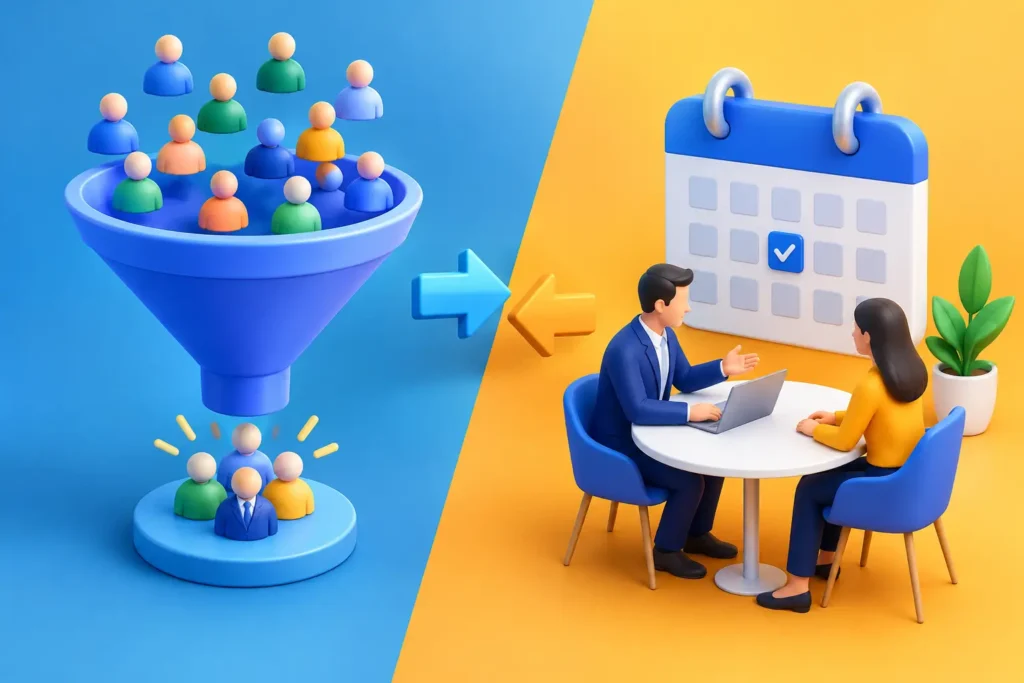


A calendar full of meetings can look like progress right up until your account executives start rejecting them. That is why a sales development partner review cannot stop at email volume, contact counts, or booked demos. The real question is whether an outsourced outbound team can create credible conversations with accounts your sales team can actually win.
For lean B2B teams, the decision has consequences beyond monthly spend. A weak partner can burn a market segment, introduce poor-fit prospects to your brand, and leave leadership with activity reports but no pipeline. A capable partner operates like part of your go-to-market organization: it sharpens targeting, executes outreach, qualifies opportunities, reports clearly, and improves the system every week.
What a Sales Development Partner Review Should Measure
Most vendor evaluations begin with a surface-level question: how many meetings can you book? That metric matters, but it is not sufficient for companies selling complex software, specialized services, or solutions with multiple stakeholders and longer buying cycles.
Start with the partner’s understanding of your commercial reality. Can they articulate your ideal customer profile, buying triggers, category language, objections, and sales motion? Can they distinguish a relevant account from an account that merely matches a few firmographic filters? If your product serves only a narrow set of companies, a broad database and generic cadence will not compensate for weak judgment.
Then examine the full path from list building to sales acceptance. A partner should be able to explain who researches accounts, who writes messaging, who manages sending infrastructure, who handles replies, who makes calls, and who decides whether a prospect is qualified enough to reach your calendar. Vague answers usually signal a fragmented delivery model.
A useful review also separates leading indicators from business outcomes. Deliverability, reply rates, positive responses, conversations, held meetings, sales-accepted opportunities, pipeline created, and closed revenue each reveal a different part of the system. A high reply rate can be meaningless if the replies come from companies outside your target market. Conversely, modest early engagement may be acceptable if it produces conversations with the right seniority and strong commercial fit.
Review the Strategy Before Reviewing the Volume
Outbound performance is often decided before the first email is sent. The best sales development partners do not treat prospecting as a list-purchasing exercise. They begin by turning your market knowledge into an executable account strategy.
ICP definition and account selection
Ask how the partner defines your ICP in practical terms. Industry, employee count, and location are useful starting points, but sophisticated targeting usually goes further. It may include technology environment, funding status, growth signals, hiring patterns, operational complexity, compliance requirements, geographic expansion, or a change in leadership.
Request examples of account selection logic. You should understand why a company belongs in the campaign and why another company does not. If your total addressable market is limited, precision matters more than scale. A partner that reaches 500 marginal accounts can create more damage than one that reaches 100 well-researched accounts.
Messaging and channel design
Review sample outreach, not just polished case-study copy. Strong messages demonstrate relevance quickly, offer a credible reason to engage, and avoid pretending every prospect has the same priority. Hyper-personalization does not mean inserting a recent company announcement into a template. It means connecting a specific business situation to a plausible outcome your company can help create.
Email, LinkedIn, and cold calling can work together, but the channel mix should reflect your audience. Senior technology executives may respond differently than operations leaders at specialized service firms. Some categories need a direct call after relevant email outreach. Others require patient, education-led sequences. A partner should have a reason for its recommended approach, not simply a standard cadence applied to every client.
Assess the Team You Will Actually Get
A sales development partner is not software with a service layer. The people behind the campaign determine whether your positioning survives contact with the market.
Ask for role-level clarity. Who owns go-to-market strategy? Who performs prospect research? Who develops messaging? Who manages CRM and outreach workflows? Who conducts calls and handles live prospect conversations? Who is accountable for weekly optimization? A single point of contact can simplify communication, but it should not hide the fact that no one owns a critical function.
For US-focused selling, the location and experience of the BDR team can also matter. US-based representatives may have stronger familiarity with local business language, procurement expectations, and executive communication norms. That does not make every offshore model ineffective, but it is a meaningful trade-off when your offer requires nuanced discovery or high-trust conversations.
You should also ask whether the team will learn from your closers. The fastest improvements often come from a tight feedback loop: BDRs hear objections, account executives report on meeting quality, and campaign strategy adjusts before the same problem affects another hundred prospects. A partner that works in isolation will optimize for what it can see, which is usually top-of-funnel activity rather than revenue quality.
Look Closely at Qualification and Handoff
The handoff is where many meeting-generation programs fail. A prospect can be interested without being qualified. They may be too small, too early, outside your geography, missing a key requirement, or simply not connected to a real business priority.
Define what qualifies a first meeting before launch. Depending on your sales motion, that may include account fit, relevant title, current initiative, pain or opportunity, timing, technical environment, budget range, or access to a buying committee. Not every condition needs to be met in the first conversation. Requiring full discovery before a meeting can reduce volume unnecessarily. Still, the partner should collect enough context for an account executive to enter the call prepared.
Review how opportunities arrive on your calendar and in your CRM. The handoff should include contact details, account research, engagement history, stated reason for interest, qualification notes, and next-step expectations. If a prospect only replied, “Sure, send time,” your seller needs to know that. Honest context protects sales capacity and makes reporting more useful.
Also clarify meeting ownership. What happens if a prospect reschedules, no-shows, or later proves to be out of scope? No-show rates are not always the partner’s fault, but they should be measured, followed up, and treated as part of the operating model.
Demand Transparent Reporting and a Real Optimization Cadence
A monthly dashboard with large activity numbers is not operational visibility. Your leadership team should be able to see what the outbound engine is doing, what it is learning, and what will change next.
At a minimum, reporting should connect campaigns to account segments, personas, channels, engagement, meetings booked, meetings held, and sales acceptance. The most useful reports add qualitative insight: which messages are producing the right conversations, which objections recur, where prospects are dropping off, and which markets deserve additional focus.
The cadence matters as much as the dashboard. Weekly working sessions create room to refine targeting and messaging while the campaign is active. Monthly business reviews help leadership assess pipeline quality, conversion trends, and investment decisions. If the partner can only discuss results after a quarter has passed, you are paying too long to discover whether the strategy was wrong.
Be cautious with guarantees that focus only on meeting volume. A meeting target can be helpful when it is paired with clear qualification rules and shared accountability. Without those safeguards, it can incentivize a vendor to prioritize easy bookings over commercially valuable opportunities.
Compare Cost Against the Internal Alternative
The right comparison is not simply agency fee versus BDR salary. Building an internal sales development function requires recruiting, management, onboarding, sales enablement, data providers, outreach tools, calling systems, deliverability infrastructure, campaign operations, and time to ramp. A single new hire rarely covers all of that.
That does not mean an external partner is always the right answer. An internal team may be preferable when you have a proven outbound playbook, sufficient management capacity, high and stable prospect volume, and a long-term plan to build a larger revenue organization. But if your team needs to test a new segment, create pipeline without adding five separate roles, or establish a repeatable outbound motion quickly, an embedded partner can be the more disciplined choice.
Evaluate contract terms with the same rigor. Look for clarity on implementation, technology access, data ownership, campaign approval, exit conditions, and the work completed if priorities change. Flexibility has value, but so does enough commitment for the partner to learn your market and improve performance beyond the first few weeks.
Questions That Expose a Weak Partner
A direct conversation will reveal more than a polished proposal. Ask how the partner would handle a campaign with low positive response but high opens, how it decides when an account list is exhausted, and what evidence it uses to change a message. Ask for examples of meetings that were rejected by clients and what the team changed afterward.
You should also ask what the partner needs from you. A credible operator will not claim it can succeed with zero client participation. It should need access to product expertise, customer insights, sales feedback, and timely approval from a designated internal owner. The difference is that a strong partner turns that input into execution rather than sending the work back to your team.
Oppify’s model is built around this distinction: a managed outbound function should bring business-development leadership, sales enablement, go-to-market engineering, and BDR execution into one accountable operating unit. The value is not a larger contact list. It is a repeatable process that gives sales teams qualified conversations worth pursuing.
The best partner review ends with a practical decision: can this team represent your company well, learn quickly, and take responsibility for creating real pipeline? If the answer is uncertain, keep evaluating. Your outbound motion deserves more than activity. It deserves an operating partner that makes every qualified conversation count.