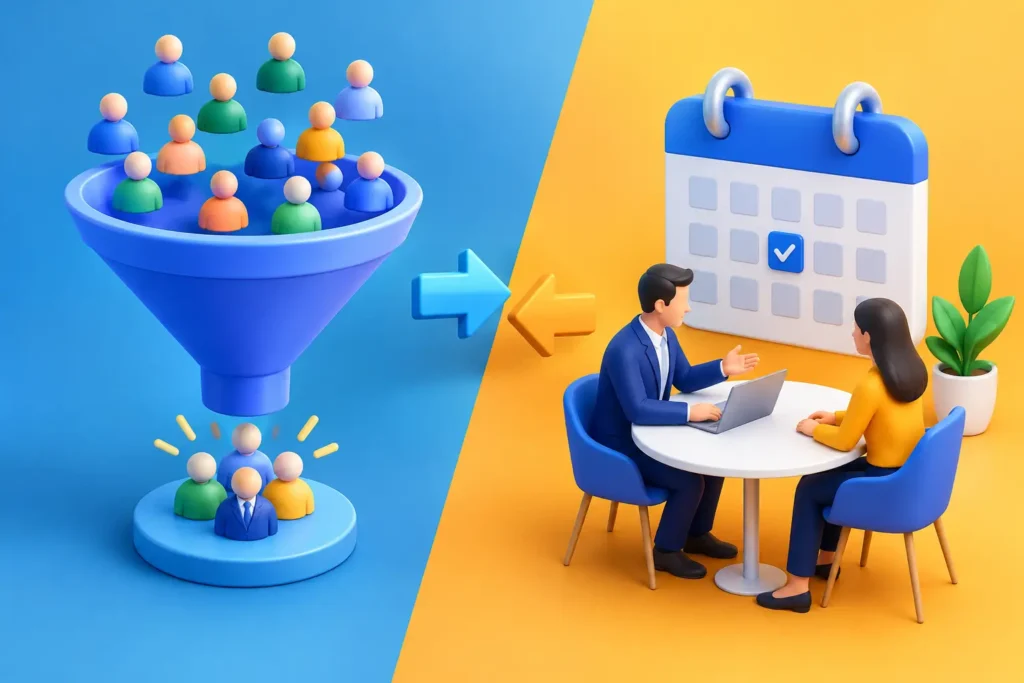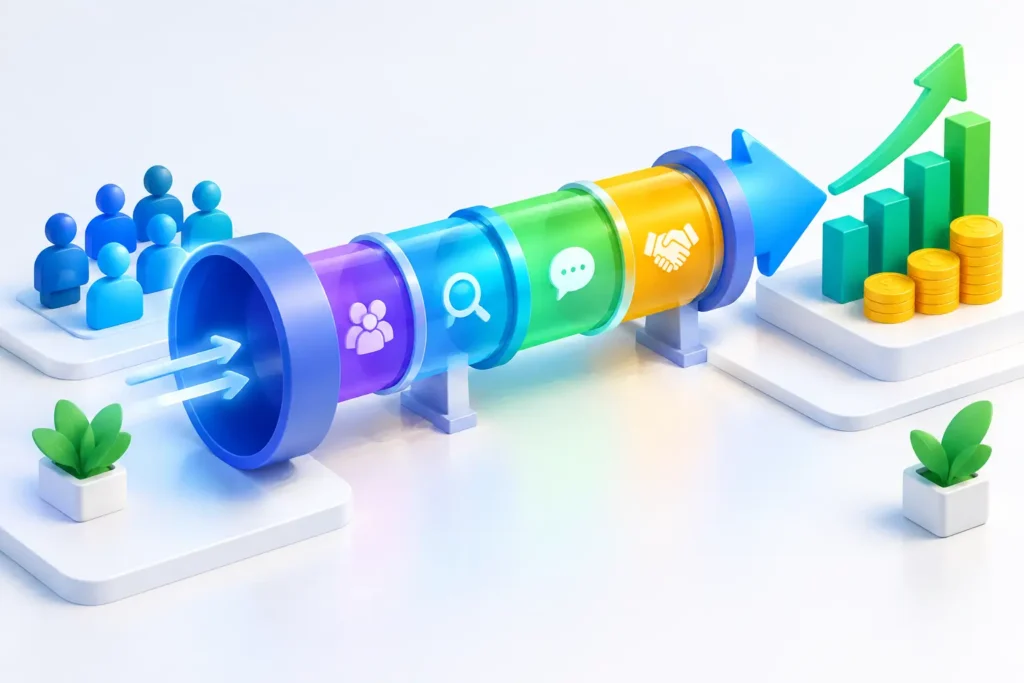


A SaaS pipeline growth case study should not begin with an email open rate. It should begin with the commercial problem: a growth-stage company has a credible product, capable closers, and an aggressive revenue target, but not enough qualified conversations with accounts that can actually buy.
That was the situation in this representative, anonymized operating case. The company sold a specialized SaaS platform into mid-market and enterprise teams. Its founder-led sales motion had produced early customers, but referrals and inbound demand were too uneven to support the next stage of growth. The sales team needed meetings. More specifically, it needed meetings with senior stakeholders at accounts that matched the company’s buying criteria.
The answer was not a larger lead list or a higher volume of generic messages. It was a disciplined outbound system built around account selection, relevant positioning, multichannel execution, and rigorous follow-up.
SaaS Pipeline Growth Case Study: The Starting Point
The company had a defined product category but an ICP that was still too broad to guide daily outbound work. Sales described the best prospects as “mid-market companies that need better visibility.” That statement was directionally correct and operationally weak. It did not tell a BDR which accounts to prioritize, which leaders to contact, or what business event made an account worth pursuing now.
Its prior outbound efforts reflected that ambiguity. Contact lists mixed strong-fit accounts with companies that lacked the budget, technical environment, or business urgency to purchase. Messaging leaned heavily on product features. Follow-up was inconsistent because the same lean team was handling prospect research, prospecting, demos, proposals, and customer work.
The issue was not effort. It was missing funnel infrastructure.
Before launching campaigns, the team set a practical definition of a qualified first meeting. A meeting had to include an account within the target market, a relevant decision-maker or strong internal champion, and a recognizable problem the SaaS platform could address. Accounts were further assessed for buying potential, timing signals, and likely sales complexity. This gave everyone the same standard for measuring pipeline quality.
The GTM Decision: Narrow the Market Before Scaling Activity
The first major change was reducing the addressable market into segments the company could win. Rather than treating all mid-market businesses as equal, the team prioritized organizations with a specific operating model, a known workflow gap, and enough complexity for the product’s value to be clear.
That segmentation produced three outbound plays. The first targeted companies already using adjacent technology, where the message could focus on filling a visible gap. The second focused on firms in a high-growth phase, where manual processes were becoming expensive and hard to manage. The third targeted larger accounts with a compliance or reporting trigger that made the platform’s business case more urgent.
This approach reduced total prospect volume at the start. That was intentional. A smaller set of well-researched accounts is usually more valuable than thousands of contacts with no credible reason to respond. For SaaS companies with lean sales teams, activity is not the goal. Productive sales conversations are.
Building the Account and Contact Map
Each target account received more than a firmographic label. The prospecting process captured relevant business context: recent hiring patterns, product changes, technology indicators, organizational structure, likely process owners, and trigger events. The goal was to give the outbound team a reason to contact an account and a useful angle for the first conversation.
The contact strategy also changed. Instead of sending every message to a single senior title, the team mapped buying groups. Executive sponsors, functional leaders, technical evaluators, and potential day-to-day users each received outreach tied to their likely priorities.
A VP may care about revenue exposure or operational cost. A director may care about reporting accuracy, workload, and process control. A technical stakeholder may care about implementation risk and compatibility. The core value proposition stayed consistent, but the framing did not.
The Campaign: Human Relevance Supported by Automation
The outbound motion combined cold email, LinkedIn outreach, and cold calling. These channels were not run as separate campaigns. They were coordinated around the same account-level narrative, with each touch designed to add context rather than repeat the same pitch.
Email created a concise business case. LinkedIn established familiarity and gave prospects a lower-friction way to engage. Calls were used to test relevance directly, surface objections, and reach contacts who rarely respond in writing. Automation handled workflow, sequencing, research enrichment, and activity tracking. People handled judgment: whether an account was worth pursuing, what message would land, when to call, and whether a response indicated genuine buying potential.
The strongest messages did not claim that the platform could solve every problem. They named a specific operating issue and connected it to a likely business consequence. For example, rather than leading with a product walkthrough, an outreach sequence could point to the cost of managing a critical workflow through disconnected systems as the company scales.
That distinction mattered. Feature-led outreach asks a prospect to care about a tool they have not seen. Problem-led outreach gives them a reason to examine the status quo.
Follow-Up Was Treated as a Revenue Process
Many outbound programs fail after the first reply. A prospect asks a question, says timing is not right, or refers a colleague, and the thread goes cold because no one owns the next step. In this case, every meaningful response entered a clear follow-up path.
Interested contacts received timely, specific replies. Referrals were researched before outreach resumed. Accounts with a later buying window were placed into a relevant nurture cadence instead of being marked as closed-lost. When a meeting was booked, the sales team received account context, contact details, the outreach narrative, and any identified pain points.
That handoff protected the work done before the calendar invite. A qualified meeting is not simply a scheduled event. It is the beginning of an informed sales process.
What Changed in the Pipeline
Within the first campaign cycles, the team learned that one initial segment generated replies but few qualified meetings. Prospects were curious about the category but lacked the operational pain or budget authority to move forward. The team did not try to solve that problem with more volume. It changed the targeting criteria and shifted effort toward the segment where urgency was clearer.
That decision improved the quality of booked conversations and reduced time spent by account executives on low-probability demos. The company also gained a more reliable view of what made an account convert: a defined trigger, multiple relevant stakeholders, and a message tied to a measurable business cost.
The important result was not a vanity metric. It was a repeatable pipeline mechanism. Leadership could see which segments were being worked, which personas were responding, where meetings came from, and what feedback should shape the next campaign. Instead of waiting for sporadic inbound demand, the company had an operating rhythm for creating net-new opportunities.
What This Case Study Means for SaaS Leaders
Outbound works best when it is treated as a managed go-to-market function, not a temporary volume project. The trade-off is that the early work is more demanding. Teams must define the ICP precisely, research accounts, develop useful points of view, and maintain consistent follow-up. But that discipline creates a far better foundation than buying a list and sending generic sequences.
It also depends on the sales motion. A low-cost, self-serve product may benefit from broader reach and faster experimentation. A complex SaaS sale with multiple stakeholders, procurement scrutiny, and a longer implementation cycle needs more account-level precision. The higher the deal value and the greater the buying complexity, the less room there is for generic outreach.
For lean revenue teams, the question is not whether outbound can create pipeline. The question is whether the company has the people, process, and technology to operate it consistently while closers stay focused on advancing real opportunities. An embedded outbound function such as Oppify can provide that coverage without forcing a company to hire, train, and manage a full internal BDR department before the motion is proven.
The next useful step is not to send more messages. It is to identify the accounts where your product has a defensible reason to matter now, then build the follow-up discipline to turn that relevance into a sales conversation.