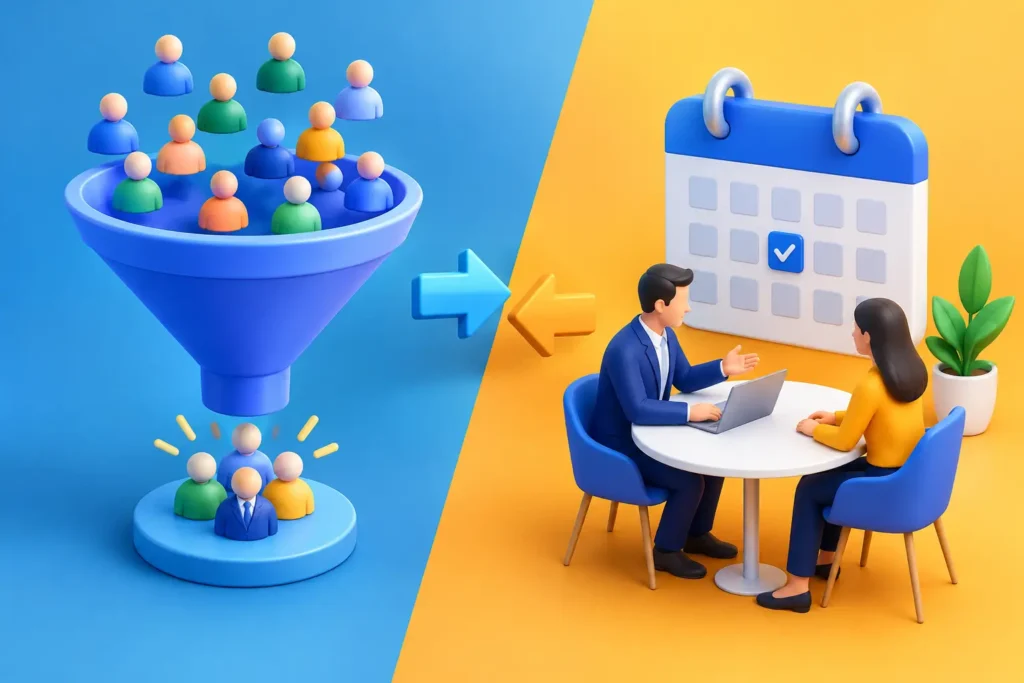

A calendar full of demos is not the same as a pipeline full of opportunity. Meeting generation agencies earn their place when they create conversations with the right accounts, the right buying roles, and enough context for an AE to move the deal forward. For lean B2B teams, that distinction determines whether outbound becomes a revenue channel or an expensive stream of activity.
The best agencies do not simply deliver names, email sends, or a monthly meeting count. They operate as an extension of the go-to-market team, connecting market strategy to prospecting, messaging, engagement, qualification, and disciplined follow-up. The result should be a repeatable system that gives leadership visibility into what is working, what is not, and where the next qualified opportunities will come from.
What Meeting Generation Agencies Actually Do
A conventional lead vendor may sell a contact list, run a generic email sequence, or pass along anyone willing to accept a call. That model can create volume, but volume without fit creates a downstream problem for sales. AEs waste time on companies with no buying urgency, no relevant use case, or no realistic path through procurement.
A capable meeting-generation partner starts earlier. It helps define the ideal customer profile, identify the accounts most likely to have a relevant problem, map the stakeholders involved, and build a reason to start a conversation now. Then it runs coordinated outreach across email, LinkedIn, and phone while tracking engagement and managing the follow-up required to convert interest into a scheduled meeting.
For complex B2B products, this work is not a one-channel task. A technical buyer may respond to a detailed email after seeing a LinkedIn touchpoint. A senior executive may ignore five messages and answer a concise cold call because the timing is right. The agency needs enough process discipline to coordinate those touches and enough human judgment to recognize when a prospect deserves a tailored response.
That is why the operating model matters as much as the appointment count. A five-person function that includes business-development leadership, sales enablement, GTM engineering, and experienced BDR execution can cover far more ground than a single SDR working from an untested script.
Why Pipeline Quality Starts Before Outreach
Outbound performance is often blamed on copywriting or deliverability. Both matter, but the larger issue is usually targeting. If the account list is wrong, better subject lines only help you get rejected faster.
A useful ICP is more specific than an industry label and employee range. It includes commercial signals such as growth stage, market motion, technology environment, buyer maturity, hiring patterns, geographic focus, customer profile, and likely trigger events. A cybersecurity provider selling into mid-market healthcare organizations, for example, needs a different account strategy than a specialized services firm targeting private-equity-backed manufacturers.
From there, a meeting-generation team should build segments rather than one broad campaign. Each segment needs a message that connects the prospect’s role and business conditions to a credible outcome. A VP of Sales may care about pipeline coverage and rep productivity. A COO may care about operating cost and execution risk. A founder entering the US market may care most about proving demand before committing to an internal sales buildout.
Personalization should support relevance, not perform theater. Referencing a recent funding round or a vague company announcement is not enough on its own. The outreach needs to make a clear commercial observation and show why a conversation is worth the buyer’s time. That takes research, positioning, and a practical understanding of the client’s sales motion.
The Operating System Behind Qualified Meetings
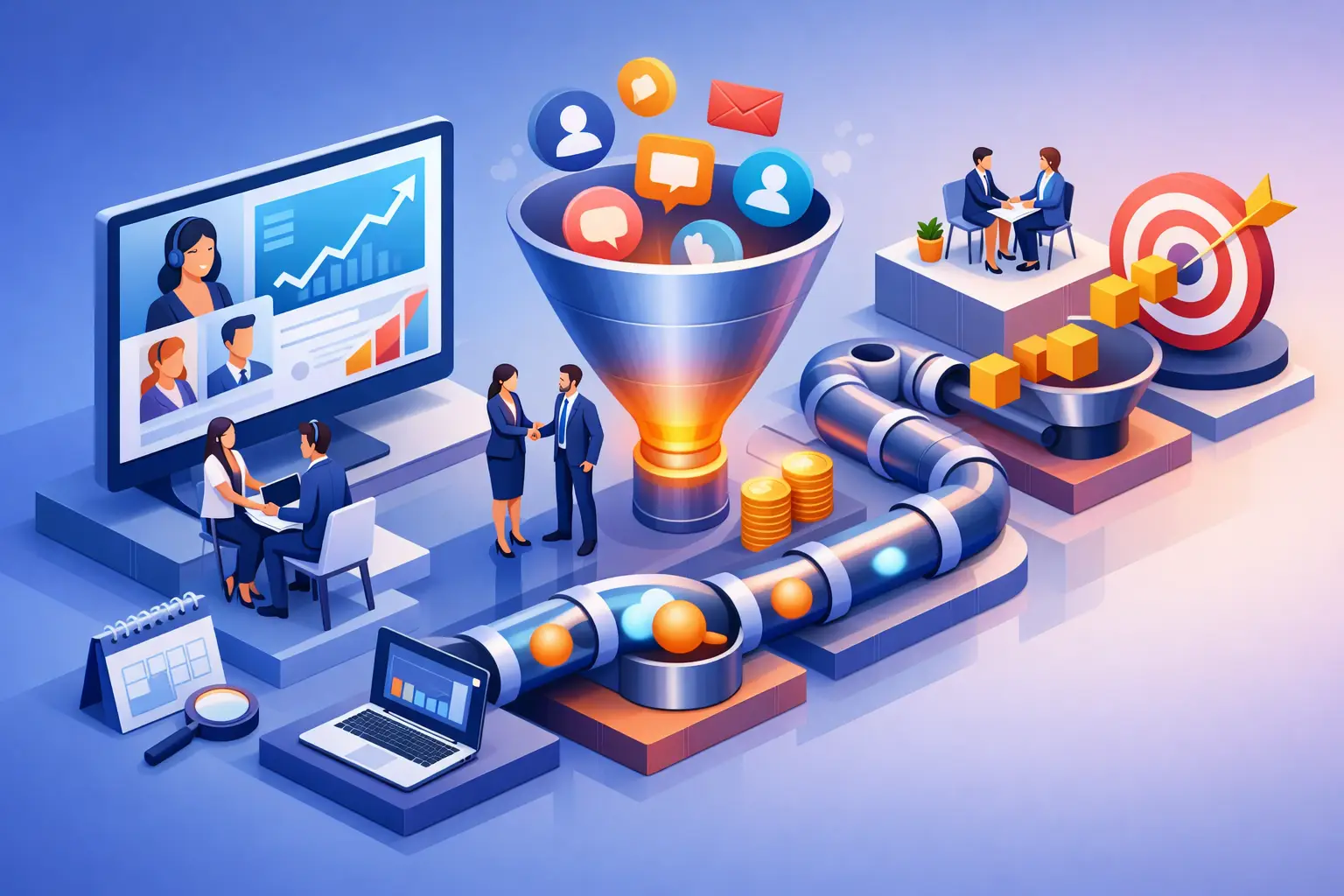
The strongest agencies build outbound as an operating system. There is a clear sequence: collaborate, prospect, outreach, create opportunities, report, and repeat. Each stage informs the next instead of operating as a disconnected service.
Collaboration begins with the offer, target market, sales process, and deal economics. The agency needs to know what a good customer looks like, what a disqualified prospect looks like, which objections repeatedly appear, and what the client can credibly promise in an initial conversation. Without this input, an outsourced team may book interest but miss the conditions that make an opportunity worth pursuing.
Prospecting is the data and research layer. This includes building account lists, verifying contacts, identifying buying committees, and prioritizing accounts with the strongest fit. AI-powered workflows can accelerate research and reduce manual data work, but they cannot replace commercial judgment. The difference between a useful signal and a distracting data point still depends on the sales strategy.
Outreach is where strategy becomes visible. Multichannel sequences should be structured enough to create consistency but flexible enough to adjust when real market feedback arrives. If prospects repeatedly challenge the same assumption, the message needs to change. If one vertical produces meaningful conversations while another does not, resources should shift. Outbound cannot be treated as a campaign that gets launched and forgotten.
Opportunity creation requires qualification and follow-through. The team should confirm basic fit, establish why the prospect agreed to talk, capture relevant context, and make the handoff easy for the closer. A booked meeting without notes, buying signals, or a defined reason for interest is less valuable than it appears on a dashboard.
Reporting closes the loop. Leadership should be able to see account coverage, activity by channel, reply quality, meetings held, conversion to qualified opportunity, objections, and emerging patterns by segment. The point is not to bury executives in metrics. It is to make decisions quickly: refine the ICP, adjust the offer, improve follow-up, or move into the segment producing the strongest pipeline.
When an Agency Is Better Than Building In-House
An internal BDR team can be the right long-term answer for companies with a mature sales motion, enough management capacity, and a proven ability to hire, train, and retain sales development talent. But early-stage and growth-stage companies often underestimate the cost and time required to get there.
Hiring one BDR does not create an outbound function. Someone still needs to define territories, source data, configure systems, write messaging, coach calls, manage deliverability, review performance, and turn market feedback into better campaigns. Then there is ramp time, turnover risk, and the cost of hiring before the motion is fully validated.
Meeting generation agencies are particularly useful when a company is testing a new segment, entering a new market, rebuilding a weak outbound motion, or needs pipeline without adding a full internal management layer. An embedded partner can bring process, technology infrastructure, and trained execution into the business faster than building each component independently.
The trade-off is real. An external team will never possess the product knowledge of a founder or tenured AE on day one. It needs access to customer stories, call recordings, objection handling, product updates, and honest feedback from sales. Companies that treat an agency as a hands-off meeting vending machine typically get weaker results. Companies that provide direction while holding the partner accountable create a much stronger operating relationship.
How to Evaluate Meeting Generation Agencies
The right question is not, “How many meetings can you book?” Ask how the agency creates meetings that can become revenue. During evaluation, look for evidence that it can handle the full outbound workflow:
- A clear method for defining ICPs, segments, account tiers, and qualification rules.
- Human-led messaging and BDR execution, supported by automation rather than replaced by it.
- US-based calling and communication capability when your buyers expect direct, credible conversations.
- Reporting that connects activity to held meetings, qualified opportunities, pipeline, and closed revenue.
- A working cadence with your sales team for feedback, call review, objection analysis, and campaign adjustments.
Also examine incentives. A low-cost provider paid solely on raw appointments may optimize for calendar volume. A true revenue partner should care about show rates, fit, opportunity conversion, and the commercial value of the accounts being engaged. Those metrics create healthier accountability on both sides.
Ask to see how the team responds when a campaign underperforms. The answer reveals more than a case study does. Strong operators can explain whether the problem sits in the market, list quality, positioning, channel mix, offer, follow-up, or sales handoff – and what they would change first.
Make Outbound a Revenue Discipline
Outbound works when it is treated as a managed revenue discipline, not a batch of cold emails. It requires a clear market thesis, focused account selection, credible messaging, consistent human follow-up, and a feedback loop that improves execution every week.
Oppify is built around that model: an embedded outbound team that handles the work required to open qualified conversations while your closers focus on advancing revenue. The goal is not activity for activity’s sake. It is to create a dependable path from targeted accounts to real sales opportunities.
If your sales team can close but lacks the capacity to create enough qualified first conversations, start by tightening the definition of a meeting worth having. That decision will improve every part of the outbound engine that follows.