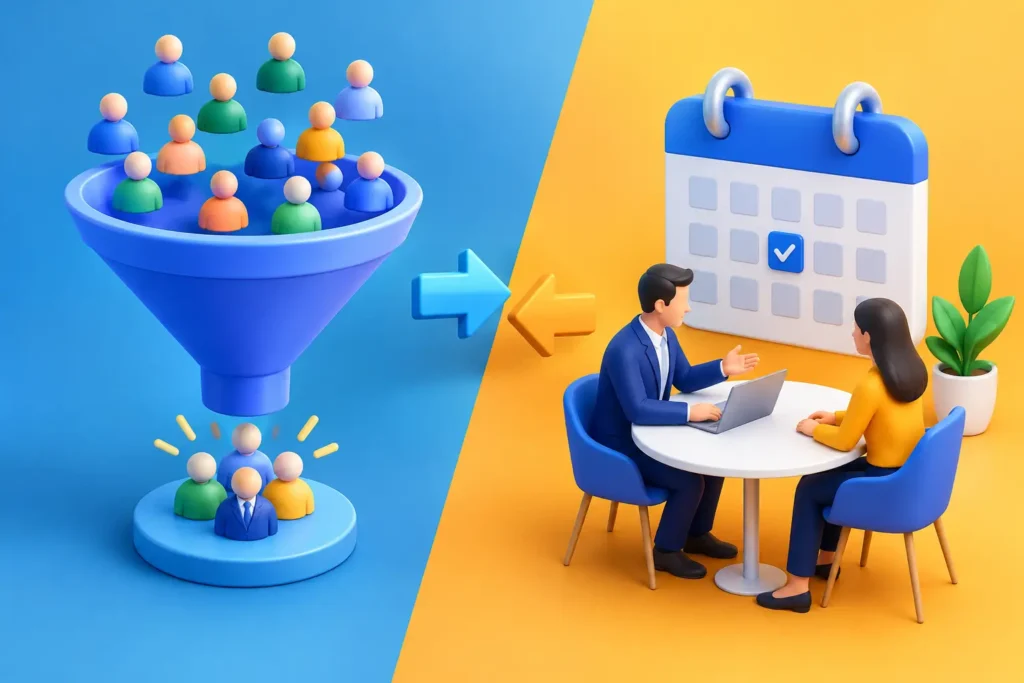


A weak pipeline problem rarely starts with a lack of contacts. It starts when nobody owns the full path from account selection to a qualified conversation. Sales outsourcing can solve that problem, but only when it is treated as an operating function, not a vendor relationship built around sending more emails.
For growth-stage B2B companies, the appeal is straightforward: building an internal outbound team takes time, capital, management attention, data infrastructure, and a repeatable playbook that many companies have not yet proven. The wrong outsourced partner adds activity without creating opportunities. The right one gives your sales organization an accountable meeting-generation engine while your closers stay focused on advancing deals.
What Sales Outsourcing Should Actually Deliver
Sales outsourcing is the use of an external team to perform some or all of the sales development work required to create pipeline. That can include market research, ideal customer profile development, account selection, contact mapping, messaging, multichannel outreach, qualification, follow-up, and appointment setting.
The definition is broad, which is why results vary so widely. A list provider may call itself an outbound partner. A cold email tool may position itself as a pipeline solution. Neither replaces the judgment, discipline, and day-to-day ownership required to turn a market hypothesis into booked meetings.
For complex B2B sales, the useful model is an embedded outbound function. It should operate with clear roles: leadership to set direction and make adjustments, enablement to build messaging and qualification standards, go-to-market engineering to manage data and workflows, and experienced BDRs to execute outreach and handle early conversations. Those roles are not administrative overhead. They are what keep outbound from becoming a volume game.
The output should also be defined correctly. Activity metrics matter because they show whether the engine is operating, but they are not the finish line. Thousands of emails sent do not create revenue. A strong sales outsourcing program is measured by qualified first meetings, opportunity conversion, pipeline contribution, and the feedback it produces about your market.
When Outsourcing Is the Better Move
Outsourcing is often the right choice when a company has a credible offer and closing capability but lacks the capacity to create consistent top-of-funnel demand. Founders and sales leaders commonly reach this point after referrals, founder-led selling, or a few channel relationships have carried the business as far as they can.
It is especially useful in three situations. First, when you need to validate a new segment without committing to multiple full-time hires. Second, when your account executives are spending too much time prospecting and too little time running discovery, managing evaluations, and closing. Third, when hiring an internal BDR team would create more operational burden than your current leadership team can absorb.
The cost difference matters, but it is not the only consideration. Internal sales development requires recruiting, onboarding, compensation, management, tools, prospect data, deliverability infrastructure, training, and turnover coverage. An outsourced team can reduce ramp time because the operating system already exists. That does not mean it is automatically cheaper in every case. A company with a mature sales process, strong sales management, and enough volume to support several BDRs may benefit from building internally over time.
The better question is not, “Should we outsource forever?” It is, “What is the fastest accountable path to repeatable pipeline at this stage?”
The Inputs That Determine Sales Outsourcing Results
No outsourced team can compensate indefinitely for an unclear offer, an undefined buyer, or a sales process that does not convert. The best engagements begin with an honest assessment of the inputs.
A narrow, usable ICP
“Mid-market companies” is not an ideal customer profile. It is a broad category containing companies with different triggers, priorities, buying committees, budgets, and sales cycles. A usable ICP identifies the firmographic profile, relevant operating conditions, likely pain, buyer roles, and disqualifiers.
For example, a cybersecurity provider may target companies of a certain size, but the stronger signal could be a recent cloud migration, a new compliance requirement, or a leadership change. Those signals give an outbound team a reason to reach out now, not just a name to add to a sequence.
A message that earns attention
Hyper-personalization is not inserting a prospect’s company name into a generic email. It is connecting a relevant observation to a credible business issue and a specific reason your company can help.
That requires positioning discipline. The message should be short enough to read quickly, specific enough to feel informed, and commercially grounded enough to justify a conversation. If the offer only makes sense after a 20-minute explanation, the outreach will struggle. The work is to find the sharpest entry point, not to describe every feature or service.
Qualification standards that protect your calendar
A booked meeting is valuable only if the prospect has a plausible use case, sufficient fit, and a legitimate reason to engage. Qualification does not mean forcing every contact through a rigid checklist before they can speak to sales. It means establishing shared standards for what deserves an account executive’s time.
Define those standards before outreach begins. Agree on company size, target roles, geographic scope, urgency signals, deal potential, and exclusions. Then review meetings together. If sales rejects meetings because they are too small, too early, or outside the target segment, that feedback should reshape targeting and messaging immediately.
Fast, disciplined handoff
Outbound creates interest. Your internal team must convert that interest into a real sales process. When a prospect responds, speed matters. When a meeting is booked, the account executive needs context on the account, outreach angle, known pain points, stakeholders, and any qualification notes.
The handoff also needs a plan for no-shows, reschedules, and prospects who are interested but not ready. This is where many programs leak pipeline. Consistent follow-up is not glamorous, but it is often the difference between a positive response and a future opportunity.
What a Strong Operating Model Looks Like
The best sales outsourcing relationships have a rhythm. They do not run on a monthly report followed by vague promises to improve. They run on shared decisions, visible execution, and rapid iteration.
Start with collaboration. The outbound team should learn your product, sales motion, customer stories, objections, pricing context, and competitive environment. This is not a one-time intake call. The message improves when the team hears what happens in discovery calls and understands why opportunities move forward or stall.
Then comes prospecting. Account selection should combine market intelligence with practical prioritization. A target account list needs enough scale to support consistent outreach, but it should not be so broad that relevance disappears. Human review matters here. AI can accelerate research, surface signals, and organize data, but it cannot reliably decide which accounts deserve your brand’s attention without strategic direction.
Outreach should use the channels your buyers actually respond to. For many US B2B audiences, that means a coordinated mix of cold email, LinkedIn outreach, and cold calling. Each channel has a different role. Email creates efficient reach and supports thoughtful messaging. LinkedIn adds familiarity and context. Calling can create direct conversations and clarify whether timing, ownership, or positioning is the obstacle.
Once engagement begins, the work shifts from sending to managing conversations. Replies need timely, thoughtful responses. Objections need to be logged, not ignored. Interested contacts who are not ready need follow-up based on a real reason to reconnect. This is where US-based BDR execution can be particularly valuable for nuanced conversations with senior buyers and complex offers.
Reporting should connect activity to commercial outcomes. Your leadership team should see who is being targeted, what messages are running, response patterns, meetings booked, meeting quality, opportunity progression, and the adjustments being made. Transparency is not a dashboard full of vanity metrics. It is the ability to understand what is working, what is not, and what the team will do next.
Red Flags Before You Sign
Be cautious when a provider promises a fixed number of meetings without discussing ICP, deal size, sales cycle, or qualification. Guaranteed volume can encourage low standards and calendar stuffing. The same concern applies to providers who begin with a generic contact list before learning your market.
Another red flag is channel dependency. If the entire program relies on one email sequence or one data source, results can collapse when inbox placement changes or the audience becomes saturated. Multichannel execution is not about being everywhere. It is about building enough touchpoints to earn a response while respecting the prospect’s attention.
Finally, avoid a model where your company is expected to supply all strategy, messaging, and follow-up direction while the vendor simply executes tasks. That may work for a mature team with a proven playbook. It is not true outsourcing. It is outsourced labor, and the management burden remains with you.
Build a Partner Relationship, Not a Meeting Factory
A capable outsourced team should challenge assumptions when the target market is too broad, the message lacks urgency, or the qualification bar is unclear. That accountability is part of the value. You do not need another report telling you that response rates were low. You need a team that identifies the constraint, tests a better approach, and owns the next move.
Oppify approaches this work as an embedded meeting-generation function: collaborate, prospect, outreach, create opportunities, report, and repeat. The objective is not to manufacture interest. It is to create a disciplined, repeatable path to conversations your sales team can turn into revenue.
The most productive question to ask a sales outsourcing partner is simple: how will you learn from the market every week and convert that learning into better pipeline? Their answer will tell you whether they are selling activity or building a growth engine.